Scheduling software solved one problem. It got people into shifts. But it never answered the bigger questions: Are they the right people? At the right cost? At the right time? Traditional workforce management focuses on scheduling, attendance, and compliance, while workforce intelligence expands that view to show how time, effort, and focus convert into actual performance and results.
If your tech stack stops at “who works when,” you’re operating with half the picture. This article breaks down what comes next.
Here’s what we’ll cover:
- What workforce intelligence actually means (and how it differs from scheduling)
- The limitations of traditional workforce management platforms
- How AI and predictive analytics are changing labor decisions
- What talent intelligence looks like in practice for hourly and contingent teams
- The ROI of moving from reactive scheduling to proactive workforce orchestration
- How to evaluate whether your current tools are holding you back
Nowsta is built for this exact shift. It’s a workforce orchestration platform that combines AI-powered scheduling, talent intelligence, and real-time labor analytics in a single interface. It gives operations teams the full picture instead of just a schedule.
What Workforce Intelligence Actually Means
Workforce scheduling answers one question: Who works when? Workforce intelligence answers a fundamentally different one: How is your labor actually performing, and what should you do next?
That distinction matters. Traditional workforce management focuses on the mechanics of filling shifts, tracking attendance, and processing payroll. It’s operational. It’s necessary. But it’s also backward-looking. You’re reacting to what already happened.
Workforce intelligence represents a fundamental shift. It layers artificial intelligence, predictive analytics, and machine learning on top of your scheduling processes to create a system that doesn’t just record workforce operations. It learns from them.
The Key Differences
| Workforce Scheduling | Workforce Intelligence |
|---|---|
| Fills open shifts | Predicts which shifts will need filling |
| Tracks hours worked | Analyzes attendance patterns and employee performance |
| Reacts to callouts | Forecasts callout probability using historical data |
| Manages compliance after the fact | Enforces labor regulations in real time |
| Reports on last week | Delivers predictive insights for next month |
Think of it this way. Workforce scheduling is the steering wheel. Workforce intelligence is the GPS, the traffic data, and the weather forecast combined. One keeps you moving. The other tells you the smartest route before you even start driving.
This is the next evolution that forward-thinking organizations are investing in. Not because scheduling doesn’t matter, but because scheduling alone doesn’t give you a deeper understanding of how labor decisions affect business outcomes.
Limits of Traditional Workforce Platforms

Most traditional workforce management platforms were built to solve a logistics problem: get the right number of people into the right shifts. And for a while, that was enough.
It’s not anymore.
Here’s where existing systems tend to hit a wall:
- They’re reactive, not predictive. Traditional platforms tell you what happened. They rarely tell you what’s about to happen. Without predictive analytics, you’re stuck in reactive management, scrambling to fix problems that smarter systems would have flagged days ago.
- They ignore external factors. Weather, local events, seasonal demand shifts, and economic changes all impact staffing levels. Legacy workforce technology doesn’t account for any of it. Your schedule looks great on paper until a snowstorm cuts your team in half.
- They create data silos. When scheduling, payroll, time tracking, and talent sourcing live in separate tools, you lose the ability to make data-driven decision-making a reality. Operations teams end up spending valuable time reconciling data across platforms instead of focusing on strategic initiatives.
- They flatten the employee experience. Basic scheduling tools treat every worker as an interchangeable unit. They don’t factor in employee preferences, skills, certifications, or development goals. That lack of personalization drives down employee engagement and, eventually, retention.
Pro tip:If your current platform can’t answer “What will my labor costs look like next Thursday at 3 PM?” without someone manually pulling reports, it’s a reporting tool. Not an intelligence platform.
The administrative burden of managing these disconnected systems compounds as you scale. What works for 50 employees becomes a bottleneck at 250. And by the time you’re running workforce operations across multiple locations, the limitations aren’t just inconvenient. They’re directly impacting operational efficiency and your bottom line.
How AI Changes Labor Decisions
For decades, scheduling decisions were made the same way: a manager looked at a spreadsheet, checked availability, and built a schedule based on experience and gut instinct. It worked. Barely.
AI-powered workforce scheduling changes the entire decision-making framework. Instead of relying on human judgment alone, AI systems combine historical data, real-time inputs, and machine learning models to make staffing recommendations that are faster, cheaper, and more accurate.
What AI Actually Does Differently
- It learns from historical patterns. AI scheduling systems analyze months or years of data to identify patterns in demand, attendance, and labor costs. They spot trends that no human could catch manually, like the fact that callout rates spike 23% on the Monday after a holiday weekend at your downtown location.
- It forecasts demand with precision. Using predictive analytics, AI-powered scheduling tools factor in external factors such as weather, local events, and seasonal trends to generate optimized staffing levels for every shift. This isn’t guesswork. It’s intelligent automation backed by data.
- It reduces bias in scheduling decisions. When managers build schedules manually, unconscious bias creeps in. Favorite employees get the best shifts. Newer workers get overlooked. AI-driven scheduling creates systems that ensure fair distribution based on skills, availability, and employee preferences, which directly improves employee satisfaction.
- It adapts in real time. When someone calls out at 6 AM, an ai powered system doesn’t wait for a manager to wake up and start texting. It instantly identifies the best available replacement based on qualifications, proximity, overtime status, and labor costs. The shift gets filled before most people finish their coffee.
The Ethical Considerations
AI isn’t replacing human judgment. The best implementations augment it. Managers still make final calls. But they make them armed with predictive insights, real-time data, and recommendations that would take hours to compile manually.
Forward-thinking companies treat AI as a co-pilot. Not an autopilot.
Nowsta’s AI-powered platform is built on this principle. It uses demand forecasting and talent intelligence to recommend the best scheduling decisions while keeping operations teams firmly in control. The result is reduced labor costs, fewer coverage gaps, and engaged employees who trust the process.
Talent Intelligence for Hourly Teams
Hourly and contingent workers aren’t a monolith. They have different skills, different availability windows, different reliability histories, and different career goals. Treating them all the same is why frontline teams stay understaffed and overtired.
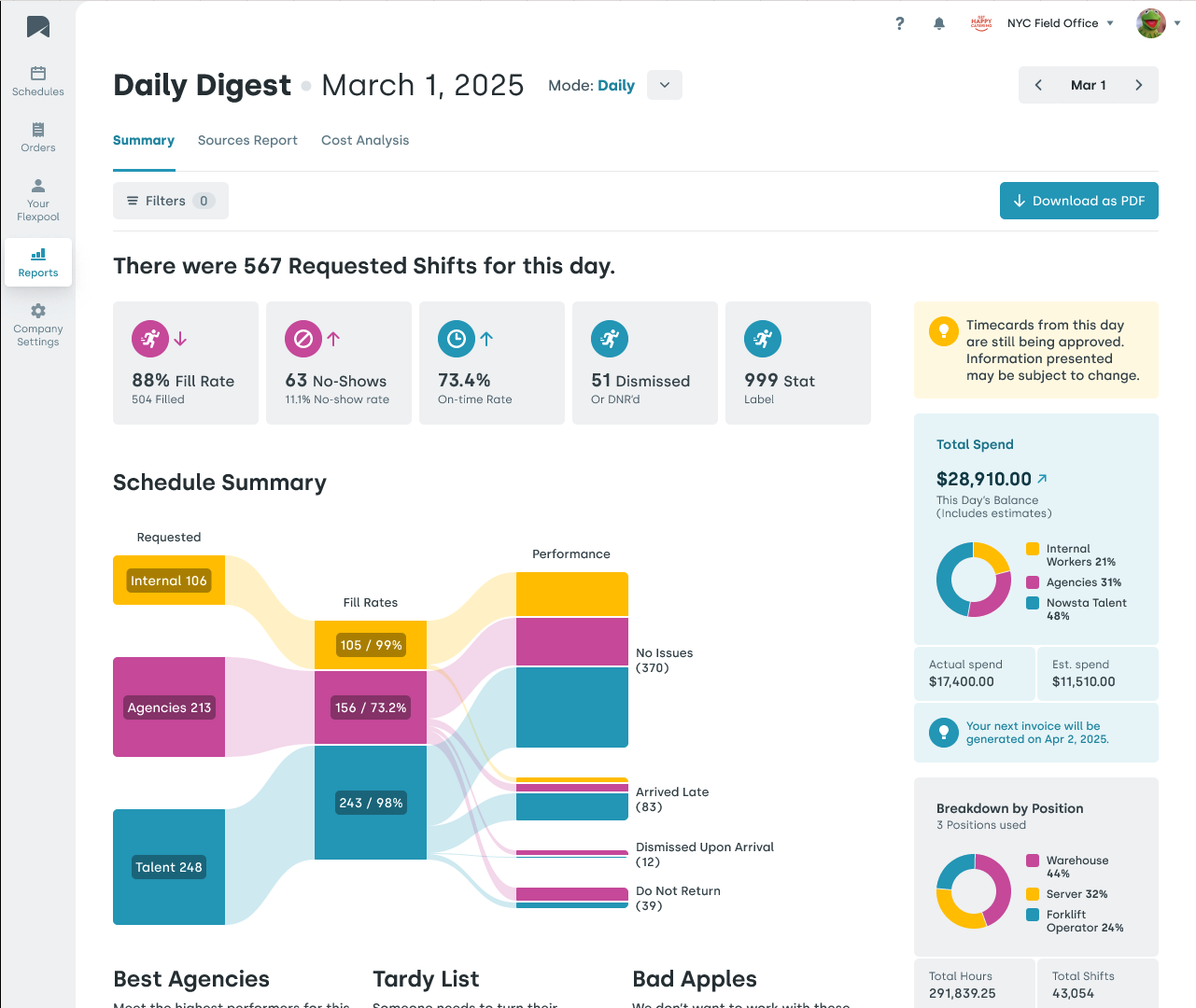
Talent intelligence changes that. It takes the data your organization already collects, like attendance patterns, performance ratings, certifications, and shift feedback, and turns it into actionable insight.
What This Looks Like in Practice
- Skills-based matching. Instead of filling a shift with whoever is available, talent intelligence matches workers to shifts based on verified skills, certifications, and past performance. This improves service quality and reduces the need for on-the-job corrections.
- Reliability scoring. Not all workers have the same no-show rate. AI can identify patterns in who consistently shows up, performs well, and stays engaged. That data helps managers build stronger schedules with fewer last-minute surprises.
- Proactive retention signals. When an employee’s hours drop, their shift swap requests increase, or their attendance patterns shift, talent intelligence flags it. You can have a conversation before they hand in a two-week notice, addressing employee burnout before it becomes turnover.
- Contingent workforce optimization. For industries like catering, events, and staffing, where contingent labor is the norm, talent intelligence tracks worker history across multiple assignments. You build a bench of proven talent instead of starting from scratch every time.
Pro tip: The best talent intelligence doesn’t just help you fill shifts. It helps you identify which workers are ready for more responsibility, which reduces your dependency on external hiring.
This is where Nowsta’s talent intelligence capabilities shine. The platform integrates sourcing, scheduling, and performance data into a single view, so operations teams can see exactly who their best workers are, where the gaps exist, and how to build a more reliable, engaged workforce over time.
ROI of Proactive Workforce Orchestration

Reactive management is expensive. You pay overtime premiums. You absorb turnover costs. You lose workforce productivity to coverage gaps and last-minute scrambles. And you never quite know where the money went because the data lives in six different spreadsheets.
Proactive workforce orchestration flips that equation. Instead of responding to problems after they hit, you prevent them from happening in the first place.
Where the Financial Impact Shows Up
| Category | Reactive Scheduling | Proactive Orchestration |
|---|---|---|
| Overtime management | Discovered after payroll runs | Prevented before shifts publish |
| Coverage gaps | Filled via frantic texts | Auto-filled with AI recommendations |
| Compliance violations | Caught during audits | Blocked in real time |
| Employee turnover | Addressed after exit interviews | Predicted through attendance and engagement data |
| Labor cost visibility | Available monthly, after the fact | Available in real time, before decisions are made |
Quantifying the Shift
Industry leaders who’ve moved from reactive to proactive workforce operations report consistent gains across key metrics:
- 15-35% reduction in labor costs through optimized schedules and eliminated unnecessary overtime
- Up to 80% less time spent on administrative tasks related to scheduling
- 28% fewer no-shows when workers have mobile access, clear communication, and fair shift distribution
- Measurable improvements in employee satisfaction when schedules respect employee preferences and provide predictability
The initial investment in workforce technology pays for itself when you calculate the cost of not having it. Every month spent on existing systems that can’t forecast, can’t adapt, and can’t optimize is a month of missed opportunities for cost savings and sustainable growth.
The question isn’t whether proactive orchestration delivers a competitive advantage. It does. The question is how long you can afford to operate without it.
Are Your Current Tools Holding You Back?
This is the uncomfortable question. You’ve invested in existing systems. Your team knows how to use them. Switching feels risky. But the cost of staying put might be higher than you think.
Here’s a quick diagnostic. If three or more of these apply to you, your tools are a bottleneck, not a solution:
- [ ] Your managers spend more than 5 hours per week building and adjusting schedules
- [ ] You can’t see real-time labor costs until after shifts are worked
- [ ] Compliance tracking requires manual data collection and separate reporting
- [ ] Employees have no self-service access to schedules, swaps, or time-off requests
- [ ] You use three or more disconnected platforms for scheduling, time tracking, and payroll
- [ ] Your data quality issues prevent you from trusting your own reports
- [ ] Demand forecasting is based on gut feel, not existing data sources and historical patterns
What Forward-Thinking Companies Look For
The future of workforce management isn’t about adding more tools. It’s about consolidating into a platform that connects scheduling, time tracking, payroll, talent sourcing, and analytics in one place. Here’s what to evaluate:
- Does it use AI to optimize performance? Look for predictive analytics, demand forecasting, and intelligent shift recommendations, not just automated templates.
- Does it prioritize human-centered design? Employee well-being and engagement matter. Self-service features, mobile-first access, and schedule transparency should be standard, not add-ons.
- Does it enhance customer experiences? Better-staffed shifts translate directly to better service quality. If your scheduling tool can’t connect labor decisions to customer satisfaction, it’s incomplete.
- Does it scale? What works for one location needs to work for ten. And fifty. Look for platforms built for enterprise complexity, not small-team simplicity.
Nowsta checks every one of these boxes. It’s a workforce orchestration platform designed for the significant technological advancements shaping how businesses manage hourly and contingent labor. From AI-powered scheduling and talent intelligence to real-time analytics and seamless payroll integration, it gives operations teams the competitive edge to stop losing control and start making smarter, faster decisions.
Build Smarter Workforce Operations With Nowsta
The shift from scheduling to workforce intelligence isn’t optional anymore. It’s the dividing line between operations that react to problems and operations that prevent them. If your tools can’t predict, adapt, and optimize in real time, they’re already behind.
Here’s what to remember:
- Workforce intelligence goes beyond scheduling to connect labor decisions with business outcomes
- Traditional platforms create data silos that kill operational efficiency
- AI-powered scheduling reduces costs, improves accuracy, and respects employee preferences
- Talent intelligence helps you build a reliable bench instead of scrambling for coverage
- Proactive orchestration delivers 15-35% labor cost reductions and measurable retention gains
- If your tools can’t forecast demand or track compliance in real time, they’re holding you back
Nowsta brings scheduling, talent intelligence, payroll, and real-time analytics together in one workforce orchestration platform. Whether you’re managing hourly teams across one location or fifty, it gives you the intelligence layer that turns reactive management into a competitive advantage.
Ready to go beyond basic shift management? Nowsta turns scheduling data into actionable workforce intelligence that drives smarter decisions. Schedule a demo and see the difference for yourself.
FAQs
What Is the Future of Workforce Management?
The future of workforce management is built on AI, predictive analytics, and emerging technologies that turn scheduling into strategic decision-making. Platforms are evolving beyond basic time tracking into workforce engagement management systems that connect labor data with organizational performance.
Future trends point toward real-time demand forecasting, intelligent automation, and employee well-being as core pillars, not afterthoughts. This shift is already visible in contact centers and frontline operations, where data-driven workforce intelligence is replacing reactive, spreadsheet-based planning.
What Are the 5 R’s of Workforce Planning?
The 5 R’s are: Right people, Right skills, Right place, Right time, Right cost. Together, they form the foundation of effective workforce planning. In contact center operations and shift-based industries, hitting all five consistently requires more than manual effort.
AI-powered platforms help organizations align employee expectations with business demand, ensuring optimized staffing levels that support both organizational performance and employee well-being across every location.
What Is the 10 20 70 Rule for AI?
The 10-20-70 rule suggests that 10% of AI’s impact comes from algorithms, 20% from technology infrastructure, and 70% from people and process transformation. For workforce intelligence, this means the AI itself is only part of the equation. Success depends on how well your teams adopt the tools and how deeply they integrate into daily operations.
In contact centers and frontline environments, this is especially true. Natural language processing and intelligent automation only deliver results when paired with workforce engagement management practices that keep people at the center.
What Does the Future of the Workforce Look Like?
The future workforce is mobile-first, data-informed, and increasingly composed of blended teams mixing hourly, contingent, and full-time staff. Employee expectations around scheduling flexibility, fair treatment, and transparency are rising fast. Organizations that invest in emerging technologies like AI-driven talent intelligence and natural language processing will gain a measurable edge in contact center operations, events, hospitality, and beyond.
The companies that thrive won’t just manage people. They’ll build workforce engagement management systems that improve employee wellbeing, boost organizational performance, and adapt to future trends as they emerge.