How Event-Based Businesses Lose Money Without Real-Time Workforce Visibility
Every event business plans for what should happen. The right number of staff on the floor. Shifts covered. Labor costs within budget. But on the day of the event? A no-show triggers a chain reaction. Someone scrambles to cover. Overtime kicks in. Costs balloon. And the worst part is that nobody saw it coming because nobody had eyes on it in real time.
The financial hit of no-shows and last-minute staffing gaps is well-documented: emergency replacements often come at premium labor rates, while the remaining staff absorbs overtime to compensate. The annual turnover rate for hourly event staff sits at 63%, which means the pressure on scheduling and workforce visibility isn’t just constant; it’s compounding.
Here’s what this article covers:
Why real-time workforce visibility is a revenue issue, not just an ops issue
The hidden costs quietly bleeding event businesses dry
How no-shows, overtime, and compliance gaps snowball into serious losses
What poor scheduling visibility looks like at scale
The tools and strategies that actually fix the problem
The platform that ties all of this together is Nowsta. It’s built specifically for event-driven, hourly workforce environments, giving operations teams real-time visibility from scheduling all the way through payroll.
Why Real-Time Workforce Visibility Is a Revenue Issue
Most event operators think about workforce visibility as an HR or ops problem. Scheduling headaches, late clock-ins, missing timesheets. Administrative friction. Annoying, but manageable.
That framing is costing them money.
The reality is that every gap in visibility creates a financial gap. Not eventually. Right now, on the floor, during the event.
What “Visibility” Actually Means Here
Workforce visibility isn’t just knowing who’s on the schedule. It’s knowing:
Who actually showed up and when
Who’s approaching overtime before it triggers
Which shifts are undercovered in real time
Where labor spend is tracking against the budget as the event runs
Which workers are performing, and which ones keep creating coverage gaps
When you can see all of that as it happens, you make better decisions. When you can’t, you react. And reacting always costs more.
The Financial Blind Spot
When labor is the largest expense category, delayed visibility means teams can’t correct course early enough to protect margins. For most event businesses, labor is the largest expense. And it’s also the most unpredictable.
Over 70% of contingent labor in businesses goes unaccounted for in corporate planning, budgeting, and forecasting. Think about that in the context of a catering operation or a large venue running multiple concurrent events. You’re essentially flying blind on your biggest cost driver.
Inaccurate scheduling can result in up to 3% of a company’s annual revenue being lost due to reduced productivity and higher labor costs. For a company doing $5M a year, that’s $150,000 quietly walking out the door.
The Three Visibility Gaps That Hit Hardest
Here’s where the money actually bleeds:
Visibility Gap
What Happens Without It
Financial Impact
No real-time clock-in tracking
No-shows go undetected until it’s too late
Emergency staffing at premium rates
No live overtime monitoring
OT triggers without warning
Unplanned labor cost spikes
No spend-vs-budget dashboard
Events routinely run over budget
Margin erosion event after event
Common culprits include failure to anticipate demand, outdated workforce management systems, and the lack of real-time operational visibility. None of these are new problems. They’re just expensive ones that most teams normalize.
It’s Not Just Ops, It’s Strategy
Inadequate visibility makes it difficult to match staffing levels to actual demand, increasing labor costs, the likelihood of staff burnout, and potentially harming customer service. And poor customer service at events doesn’t just sting in the moment. It damages repeat business, referrals, and your reputation in a market that runs heavily on word of mouth.
Without workforce visibility, budget forecasting becomes guesswork, not strategy. You can’t build a scalable event business on guesswork.
The good news? A hospitality business that adopted real-time workforce management tools reported a 15% reduction in labor costs. That’s not a rounding error. That’s a meaningful margin improvement on a cost that previously felt uncontrollable.
Pro tip: The shift from reactive to proactive workforce management doesn’t require a full technology overhaul. It starts with one thing: being able to see what’s happening right now, not in the next payroll cycle.
How Nowsta Closes the Gap
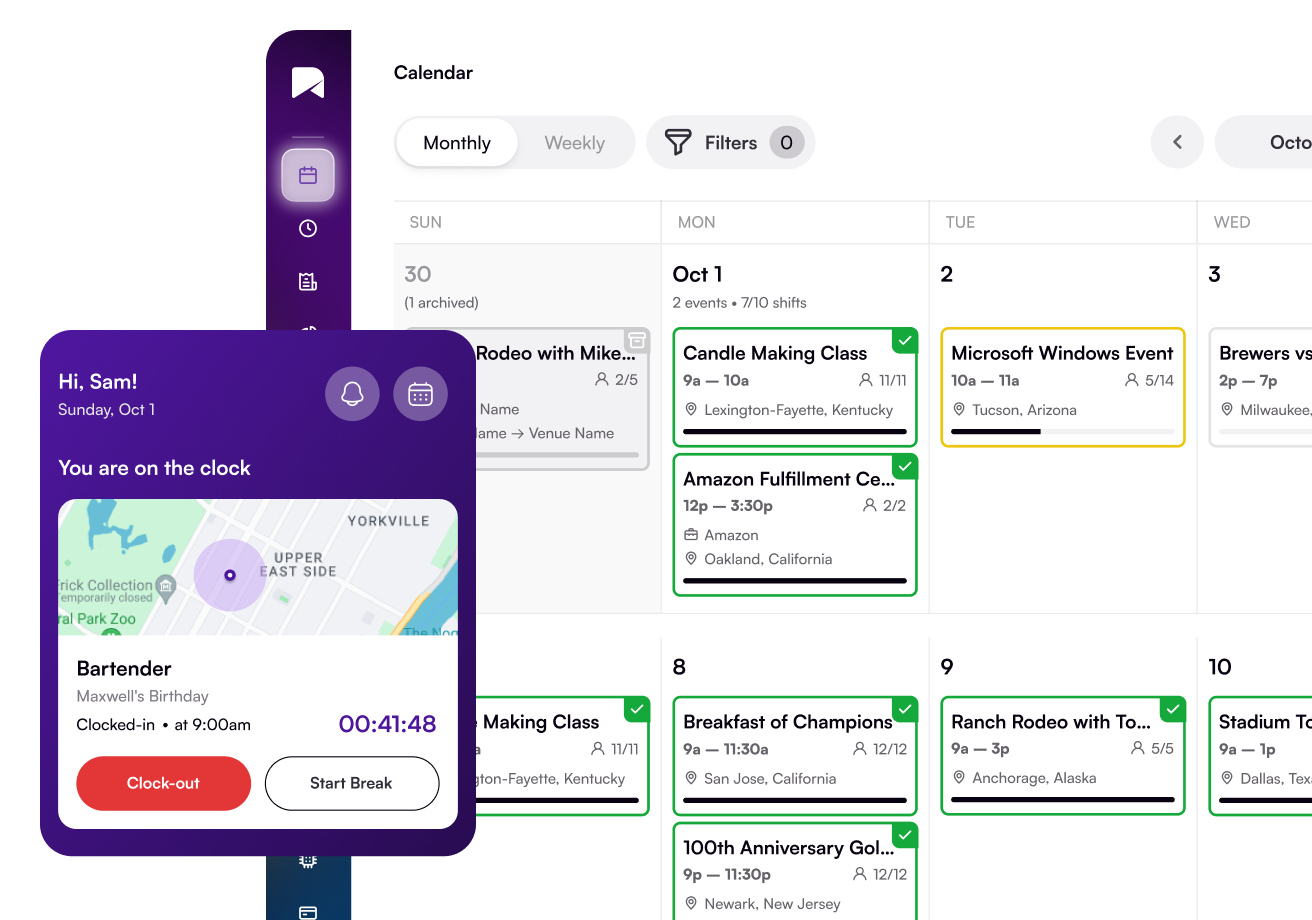
This is exactly where Nowsta’s workforce management platform earns its keep. The platform gives operations teams a live view across scheduling, time and attendance, and labor spend, all in one place. No toggling between systems. No waiting until payroll to find out you went 15% over budget on a single event.
The Hidden Costs Quietly Bleeding Event Businesses Dry
Most event operators can tell you their labor budget. Few can tell you how much of it actually leaked last month.
That’s the problem. The losses aren’t dramatic. They don’t show up in one line item. They’re distributed, scattered across payroll discrepancies, last-minute staffing calls, untracked overtime, and compliance penalties that nobody saw coming. By the time the data catches up, the money is long gone.
The Costs Nobody Talks About
Here’s what actually drains the budget in event-based operations:
Emergency staffing premiums. When a no-show hits, and you need a replacement fast, you’re not paying standard rates. You’re paying whatever it takes.
Unplanned overtime. Employees rack up unplanned extra hours due to poor scheduling visibility, inflating payroll without any strategic reason behind it.
Administrative lost time. Managers spend hours manually patching schedules, chasing confirmations, and reconciling timesheets. That’s time that doesn’t go toward running a better event.
Turnover from overwork. Employees working excessive overtime are more susceptible to burnout, and burned-out employees are 2.6 times more likely to leave. Replacing an hourly worker isn’t free. Recruiting, onboarding, and training costs add up fast.
Compliance fines. A missed meal break or a miscalculated overtime rate can translate into statutory penalties of up to $4,000 per employee in states like California alone.
What the Numbers Actually Say
Modern workforce management platforms deliver returns of up to 13x, meaning organizations gain $12.24 for every $1 invested, often with a payback period of less than five months. That’s not a sales pitch. That’s the gap between what relying on manual processes costs versus what automation costs.
For finance leaders evaluating workforce tools, the math is straightforward. Every dollar spent on visibility infrastructure offsets multiple dollars in reactive labor spend.
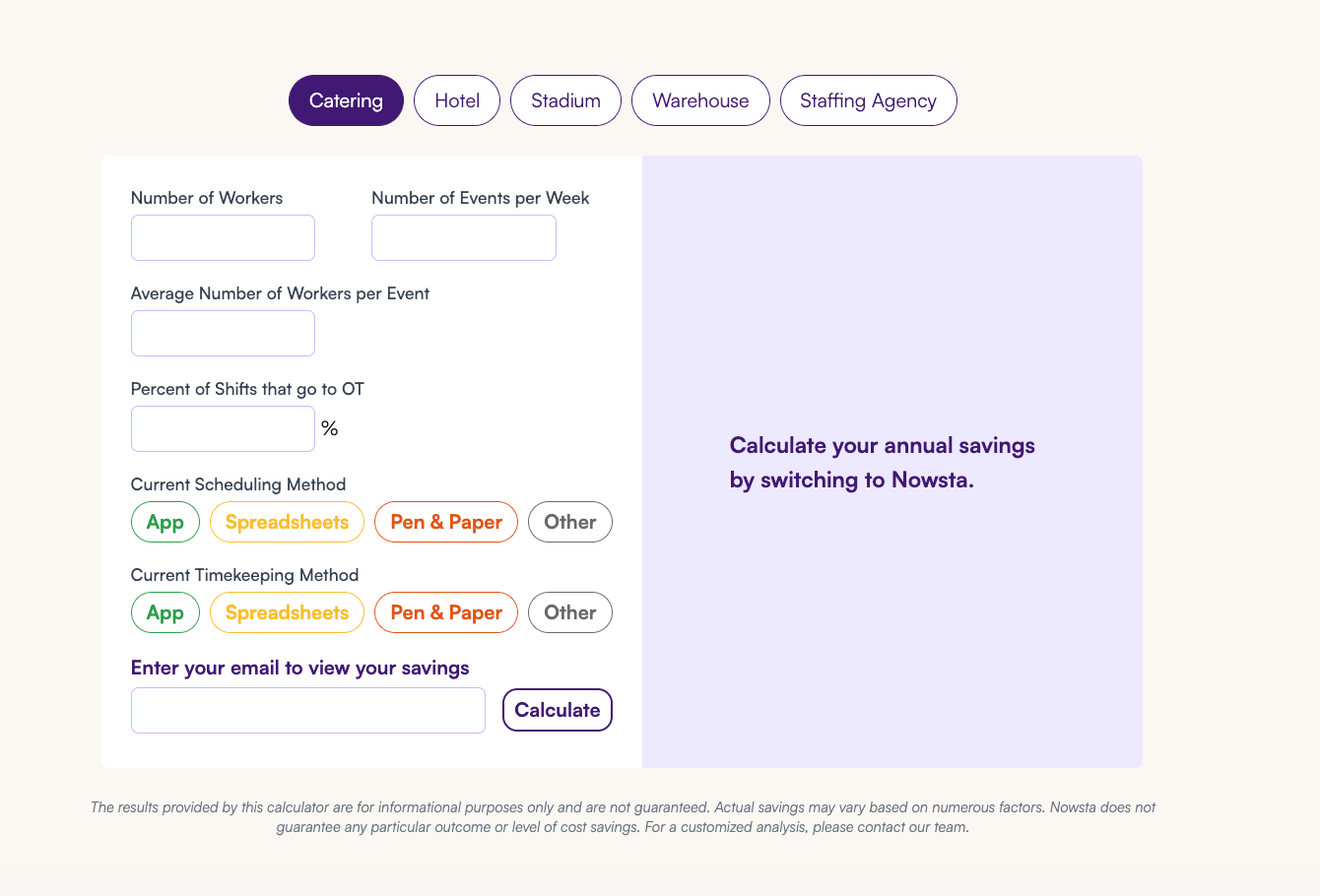
Pro tip: Use Nowsta’s cost savings calculator to run a quick estimate of what poor scheduling visibility is actually costing your operation. The number tends to surprise people.
The Reputational Damage Nobody Budgets For
There’s also a cost that doesn’t appear on any P&L. An understaffed event delivers a degraded experience. Guests notice. Clients notice. And in an industry where referrals and repeat contracts drive a significant share of revenue, one bad event can set off a chain of lost future business.
Reputational damage is real, it’s compounding, and it starts with a shift that wasn’t covered because nobody had clear data on who actually showed up.
How No-Shows, Overtime, and Compliance Gaps Snowball
These three problems feel separate. They’re not. They feed each other in a loop that gets harder to break the longer it runs.
The Snowball Effect, Mapped Out
Here’s how it typically plays out on event day:
A worker no-shows with no advance warning
The manager scrambles. Another employee gets called in, or existing staff absorb the gap
That coverage creates overtime. Unplanned. Unbudgeted.
The overtime goes unmonitored because there’s no real-time data view
Payroll closes with hours that weren’t approved and rates that weren’t anticipated
Finance leaders flag the overage after the fact, with no ability to act on it
Repeat this across dozens of events per month, and you don’t have an ops problem. You have a systemic revenue leak.
No-Shows: More Expensive Than They Look
The financial hit of no-shows extends well beyond the immediate gap. Emergency replacements come at premium rates, and if staff members must cover for absent colleagues, overtime costs compound quickly on top of the baseline labor budget.
For event businesses managing temporary workers across multiple venues, the exposure multiplies. The annual turnover rate for hourly event staff sits at 63%, which means no-shows aren’t random anomalies. They’re a predictable, recurring cost that most organizations still treat as a surprise.
Overtime: The “Fix” That Breaks Things Further
Overtime looks like a solution in the moment. It covers the shift. The event runs. But the cost structure underneath it is punishing.
Workers in jobs with overtime schedules have a 61% higher injury rate compared to those without overtime. And relying on overtime creates a vicious cycle: the more you lean on it, the more you exacerbate the root problem of burnout and turnover.
Industry data shows overtime rates have increased by more than 12% since 2022. Short staffing leads to overtime, which drives burnout and turnover, which in turn increases training costs and lowers productivity. Organizations unable to break this cycle often don’t realize it’s a visibility problem at its core.
Compliance Gaps: The Delayed Detonator
In 2026, businesses must navigate an increasingly complex web of labor regulations, including new mandates on paid leave, wage transparency, and minimum wage adjustments across different jurisdictions. Companies operating in multiple states face particular challenges, as they must comply with distinct labor codes while avoiding costly penalties that can result from even minor compliance errors.
For event businesses running operations across multiple venues or states, compliance isn’t a checkbox. It’s a live risk. And without automated monitoring built into your scheduling workflow, you’re essentially auditing after the fact, which is always too late.
Nowsta’s compliance features flag issues before they become violations, with automated alerts for overtime thresholds, break requirements, and classification rules built directly into the scheduling and time-tracking workflow. That’s not administrative support. That’s real financial protection.
What Poor Scheduling Visibility Looks Like at Scale
One event with a staffing gap is a bad day. Ten events with staffing gaps, running simultaneously, across multiple locations? That’s a broken system. And the larger the operation, the harder the problems are to spot without the right infrastructure.
The Signs Are Usually Obvious in Hindsight
Many organizations recognize poor visibility only after something breaks. Here’s what it looks like before the breaking point:
Warning Sign
What’s Actually Happening
Managers spending 8+ hours per week on scheduling
Processes are manual, siloed, and not scalable
Budget overruns on most events
No live spend-vs-budget view during operations
High no-show rates with no trend data
Historical data isn’t being captured or used
Overtime spikes every busy season
No demand forecasting or early warning alerts
Payroll discrepancies every cycle
Scheduling and time-tracking aren’t connected
Workers unsure of shift details
Communication is fragmented across texts and calls
The pattern here is clear. Each symptom points back to the same root: leaders are managing in the past instead of acting in the present.
Many Organizations Are Still Relying on the Wrong Tools
Fewer than 11% of operations currently use a solution that automatically generates schedules, and 40% still rely on manual processes like texting or calling employees to fill shifts, adding administrative burden, labor costs, and compliance risks.
That’s the industry broadly. In event-specific operations, the dependency on spreadsheets and group chats is even more entrenched. Many organizations try to patch the gap with existing tools that weren’t built for shift-based, high-turnover, multi-venue work. The result is a fragmented view: scheduling in one place, time-tracking in another, payroll in a third. No central source of truth. No ability to act on clear data until it’s too late.
What Scale Actually Demands
When you’re managing 50 workers across three simultaneous events, the complexity isn’t linear. It’s exponential. You need:
Real-time visibility into who clocked in, who’s running late, and who triggered overtime
The ability to broadcast open shifts and get confirmations fast, not in the next text chain
A clear picture of labor spend for each event as it runs
Accountability built into the system, not dependent on a manager chasing people down
Without that infrastructure, growth makes the problem worse, not better. More events mean more gaps, more overtime, more compliance exposure, and more lost time spent firefighting instead of scaling.
This is exactly the operating environment that Nowsta was built for. From real-time clock-in tracking with GPS verification to automated overtime alerts and live budget dashboards, the platform gives event operations teams the more control they need to run confidently at scale.
The Tools and Strategies That Actually Fix the Problem
The solution isn’t working harder. It’s building a system where the right decisions happen automatically, or at least with much less friction.
Here’s what actually moves the needle.
1. Centralize Everything Into One System
The single biggest upgrade most event businesses can make is moving from scattered tools to one centralized system that connects scheduling, time, attendance, and payroll. When these functions live in silos, data lags. When they connect, you get actionable insights in real time.
A centralized system also creates accountability at every level. Managers know who confirmed, who clocked in, and who’s approaching overtime. Workers get clear shift details and reminders. Nothing falls through the cracks because the system tracks it.
2. Use Historical Data to Forecast, Not Guess
Every event you’ve run is a data point. The attendance pattern from last July’s gala, the no-show rate for a specific venue, and the overtime triggers from your peak season last year. That historical data exists. The question is whether your tools are using it.
AI-powered forecasting allows employers to predict demand based on key metrics by analyzing historical data, sales trends, and other relevant factors, helping align staffing coverage and control labor costs.
Nowsta’s demand forecasting does exactly this. It analyzes past events to help you staff the right number of workers at the right time, so you’re not overstaffing quiet periods or scrambling on high-demand nights.
3. Automate the Compliance Layer
Compliance can’t be a manual task when you’re running hundreds of shifts. Automate it.
Set overtime threshold alerts so managers get notified before a worker tips over
Automate break tracking and flag violations before they become fines
Keep an audit-ready trail for every shift, clock-in, and schedule change
This is where many existing tools fall short. They track time, but they don’t flag compliance risks or connect that data to payroll in a way that eliminates errors. A purpose-built platform like Nowsta has this built in, giving operations teams the transparency and confidence they need to stay compliant without adding administrative overhead.
4. Give Workers More Control
Employee engagement isn’t just a culture metric. It’s a no-show prevention strategy. When employees feel they have a say in their schedules, confirmation rates go up and show rates follow.
Improved planning, recruitment, and employee engagement through workforce management systems correlates with 30 to 60% lower employee turnover.
Nowsta’s mobile-first platform lets workers view shifts, confirm availability, swap with teammates, and get paid faster through Instant Pay. When employees feel respected and in control of their work lives, they show up. It’s that direct.
5. Build a Clear Plan for Vendor and Agency Management
For operations relying on temporary workers from multiple agencies, visibility gets even harder without a dedicated layer of vendor management. The Nowsta vendor management platform brings all agency relationships, performance data, and contingent labor spend into one view so you can make the right decisions about which partners to lean on and which ones to phase out.
How Smarter Workforce Management Pays for Itself Fast
The ROI conversation around workforce tools often gets framed as a cost. It shouldn’t be. It’s an investment with a measurable, relatively fast return.
The Numbers Leaders Should Know
Modern WFM platforms achieve returns of up to 13x, with companies gaining $12.24 for every $1 invested and a payback period of less than five months.
That’s the aggregate picture. At the operational level, here’s what the return looks like for event-based businesses specifically:
Metric
Improvement with Nowsta
Time spent scheduling
Up to 80% reduction
Payroll processing time
Up to 90% faster
Labor cost reduction
Up to 35%
No-show rate
28% fewer
Overtime spend
18% cut in the first month
Manager hours saved weekly
Up to 12 hours
These aren’t aspirational numbers. They’re what Nowsta customers report. Organizations that commit to smarter workforce management stop relying on reactive fixes and start building a system that produces fewer surprises by design.
What Continuous Improvement Looks Like in Practice
The best operations leaders don’t treat workforce management as a one-time fix. They treat it as a loop. Each event generates data. That data informs the next forecast. The next forecast improves staffing accuracy. Better staffing accuracy reduces overtime and no-shows. And so on.
Continuous improvement requires visibility. Without it, you’re starting from zero every time.
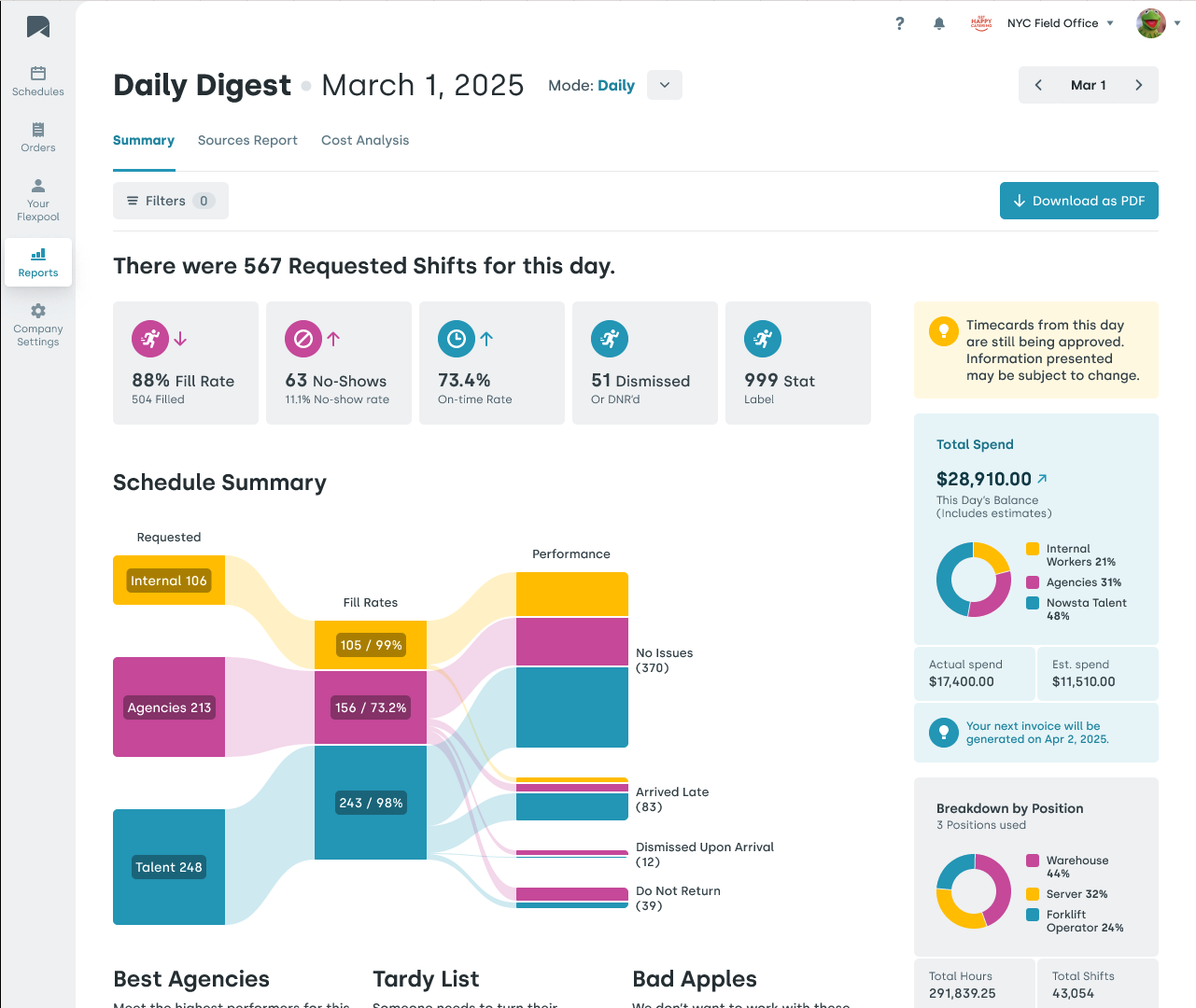
Nowsta’s reporting layer gives you clear data after every event so your team can debrief, adjust, and plan smarter for what’s next. That’s how you build an operation that gets more efficient over time, not just functional in the moment.
The Real Cost of Waiting
For many organizations, the hesitation comes down to switching costs. Migrating off spreadsheets or patched-together tools feels disruptive. But the status quo has its own cost. Every month without visibility is another month of preventable overtime, unmanaged no-shows, and compliance exposure.
When labor is the largest expense category, delayed visibility means teams can’t correct course early enough to protect margins. The more projects you run concurrently, the higher the risk that manual reconciliation will miss critical details.
Leading operations teams don’t wait for a crisis to act. They build the infrastructure before the next busy season, not after it.
If you’re ready to see what smarter workforce management actually looks like in practice, Nowsta’s demo walks you through the full platform with scenarios relevant to your operation. No generic overview. A real look at what the future of your workforce operations can be.
Stop the Bleed. Start With Nowsta.
Every dollar lost to a no-show, an unplanned overtime spike, or a compliance fine is a dollar that didn’t have to leave. The value of real-time workforce visibility isn’t theoretical. It’s measurable, and it shows up fast.
Key takeaways from this article:
Without real-time data, cost control becomes guesswork after the fact
No-shows, overtime, and compliance gaps don’t operate in isolation. They compound
Inaccurate scheduling can cost up to 3% of annual revenue in reduced productivity and higher labor costs
Recent studies confirm that organizations with holistic workforce management are nearly six times more effective at distributing work across all worker types
AI-powered forecasting, centralized scheduling, and automated compliance are essential to breaking the reactive cycle
The ROI on smarter workforce tools is fast. Most platforms pay back within five months
The good news is that every problem covered in this article is solvable. Nowsta gives every person on your operations team the ability to access real-time data, make smarter decision-making calls, and adapt quickly when things shift on event day. Teams that run on Nowsta don’t just manage their workforce more effectively. They build operations that compound in value over time, event after event.
What is real-time workforce visibility, and why does it matter for event businesses?
Real-time workforce visibility means knowing, at any moment, who clocked in, who’s approaching overtime, and how labor spend tracks against budget. For event businesses, where conditions shift fast, and labor is the highest cost, it’s essential to make sound decisions before problems become expensive.
How do no-shows actually affect an event company’s bottom line?
Beyond the immediate coverage gap, no-shows trigger emergency staffing at premium rates, unplanned overtime for remaining staff, and cascading service quality issues. Research shows the value lost compounds quickly when these gaps go undetected in real time. One no-show rarely costs just one shift.
What tools help event businesses manage workforce visibility effectively?
Purpose-built workforce management platforms like Nowsta connect scheduling, time tracking, compliance, and payroll in one centralized system. Unlike patched-together existing tools, they give leaders access to live data and actionable insights across every event so teams can adapt without scrambling.
How quickly can a smarter workforce management deliver cost control results?
Faster than most expect. Nowsta customers report up to 80% less time spent scheduling and an 18% reduction in overtime spend within the first month. For a deeper look at potential savings specific to your operation, the Nowsta cost savings calculator is a practical starting point.
Stay in the know
Subscribe to our blog and get news, insights and trends from staffing and operations experts.
We use tools on this site to collect and record your data (e.g., your searches), which we and our vendors may use to provide, improve, and personalize our offerings, make recommendations, and for analytics and marketing. By continuing, you agree to these terms.
Cookie Preferences
Manage your cookie preferences below:
Essential cookies enable basic functions and are necessary for the proper function of the website.
Name
Description
Duration
Cookie Preferences
This cookie is used to store the user's cookie consent preferences.
30 days
These cookies are needed for adding comments on this website.
Name
Description
Duration
comment_author
Used to track the user across multiple sessions.
Session
comment_author_email
Used to track the user across multiple sessions.
Session
comment_author_url
Used to track the user across multiple sessions.
Session
Google Tag Manager simplifies the management of marketing tags on your website without code changes.
Name
Description
Duration
cookiePreferences
Registers cookie preferences of a user
2 years
td
Registers statistical data on users' behaviour on the website. Used for internal analytics by Nowsta.
session
Statistics cookies collect information anonymously. This information helps us understand how visitors use our website.
Google Analytics is a powerful tool that tracks and analyzes website traffic for informed marketing decisions.
Used to monitor number of Google Analytics server requests when using Google Tag Manager
1 minute
__utmz
Contains information about the traffic source or campaign that directed user to the website. The cookie is set when the GA.js javascript is loaded and updated when data is sent to the Google Anaytics server
6 months after last activity
__utmv
Contains custom information set by the web developer via the _setCustomVar method in Google Analytics. This cookie is updated every time new data is sent to the Google Analytics server.
2 years after last activity
__utmx
Used to determine whether a user is included in an A / B or Multivariate test.
18 months
_ga
ID used to identify users
2 years
_gali
Used by Google Analytics to determine which links on a page are being clicked
30 seconds
_ga_
ID used to identify users
2 years
_gid
ID used to identify users for 24 hours after last activity
24 hours
_gac_
Contains information related to marketing campaigns of the user. These are shared with Google AdWords / Google Ads when the Google Ads and Google Analytics accounts are linked together.
90 days
__utma
ID used to identify users and sessions
2 years after last activity
__utmt
Used to monitor number of Google Analytics server requests
10 minutes
__utmb
Used to distinguish new sessions and visits. This cookie is set when the GA.js javascript library is loaded and there is no existing __utmb cookie. The cookie is updated every time data is sent to the Google Analytics server.
30 minutes after last activity
__utmc
Used only with old Urchin versions of Google Analytics and not with GA.js. Was used to distinguish between new sessions and visits at the end of a session.
End of session (browser)
Hotjar is a powerful analytics tool that helps you understand user behavior through heatmaps and session recordings.
Name
Description
Duration
_hjShownFeedbackMessage
This cookie is set when a visitor minimizes or completes Incoming Feedback. This is done so that the Incoming Feedback will load as minimized immediately if they navigate to another page where it is set to show.
365 days
_hjid
Hotjar cookie. This cookie is set when the customer first lands on a page with the Hotjar script. It is used to persist the random user ID, unique to that site on the browser. This ensures that behavior in subsequent visits to the same site will be attributed to the same user ID.
365 days
hj_visitor
hotjar uses cookies to enhance the user’s experience on our website, for example to complete forms, navigating the site, and identify returning users and offer related content. Users can control the use of cookies at the individual browser level.
Session
_hjIncludedInSample
Hotjar cookie. This session cookie is set to let Hotjar know whether that visitor is included in the sample which is used to generate funnels.
365 days
_hjClosedSurveyInvites
Hotjar cookie. This cookie is set once a visitor interacts with a Survey invitation modal popup. It is used to ensure that the same invite does not re-appear if it has already been shown.
365 days
_hjDonePolls
Hotjar cookie. This cookie is set once a visitor completes a poll using the Feedback Poll widget. It is used to ensure that the same poll does not re-appear if it has already been filled in.
365 days
_hjMinimizedPolls
Hotjar cookie. This cookie is set once a visitor minimizes a Feedback Poll widget. It is used to ensure that the widget stays minimizes when the visitor navigates through your site.
365 days
_hjDoneTestersWidgets
Hotjar cookie. This cookie is set once a visitor submits their information in the Recruit User Testers widget. It is used to ensure that the same form does not re-appear if it has already been filled in.
365 days
_hjMinimizedTestersWidgets
Hotjar cookie. This cookie is set once a visitor minimizes a Recruit User Testers widget. It is used to ensure that the widget stays minimizes when the visitor navigates through your site.
365 days
hjViewportId
This cookie stores user viewport details such as size and dimensions.
Session
_hjSessionStorageTest
This cookie checks if the Hotjar Tracking Code can use Session Storage. If it can, a value of 1 is set.
Session
_hjTLDTest
When the Hotjar script executes we try to determine the most generic cookie path we should use, instead of the page hostname. This is done so that cookies can be shared across subdomains (where applicable). To determine this, we try to store the _hjTLDTest cookie for different URL substring alternatives until it fails. After this check, the cookie is removed.
session
_hjCookieTest
This cookie checks to see if the Hotjar Tracking Code can use cookies. If it can, a value of 1 is set.
Session
_hjUserAttributesHash
User Attributes sent through the Hotjar Identify API are cached for the duration of the session in order to know when an attribute has changed and needs to be updated.
session
_hjCachedUserAttributes
This cookie stores User Attributes which are sent through the Hotjar Identify API, whenever the user is not in the sample. These attributes will only be saved if the user interacts with a Hotjar Feedback tool.
session
_hjLocalStorageTest
This cookie is used to check if the Hotjar Tracking Script can use local storage. If it can, a value of 1 is set in this cookie. The data stored in_hjLocalStorageTest has no expiration time, but it is deleted immediately after creating it so the expected storage time is under 100ms.
-
_hjHasCachedUserAttributes
This cookie sets when a user first lands on a page. Persists the Hotjar User ID which is unique to that site. Hotjar does not track users across different sites. Ensures data from subsequent visits to the same site are attributed to the same user ID.
365 days
_hjFirstSeen
The cookie is set so Hotjar can track the beginning of the user's journey for a total session count. It does not contain any identifiable information.
30 minutes
_hjIncludedInPageviewSample
This cookie is set to let Hotjar know whether that visitor is included in the data sampling defined by your site's page view limit.
30 minutes
_hjIncludedInSessionSample
This cookie is set to let Hotjar know whether that visitor is included in the data sampling defined by your site's daily session limit
30 minutes
_hjSession_
A cookie that holds the current session data. This ensues that subsequent requests within the session window will be attributed to the same Hotjar session.
30 minutes
_hjSessionUser_
Hotjar cookie that is set when a user first lands on a page with the Hotjar script. It is used to persist the Hotjar User ID, unique to that site on the browser. This ensures that behavior in subsequent visits to the same site will be attributed to the same user ID.
365 days
_hjSessionTooLarge
Causes Hotjar to stop collecting data if a session becomes too large. This is determined automatically by a signal from the WebSocket server if the session size exceeds the limit.
session
_hjSessionRejected
If present, this cookie will be set to 1 for the duration of a user’s session, if Hotjar rejected the session from connecting to our WebSocket due to server overload. This cookie is only applied in extremely rare situations to prevent severe performance issues.
session
_hjSessionResumed
A cookie that is set when a session/recording is reconnected to Hotjar servers after a break in connection.
session
_hjptid
This cookie is set for logged in users of Hotjar, who have Admin Team Member permissions. It is used during pricing experiments to show the Admin consistent pricing across the site.
session
_hjAbsoluteSessionInProgress
The cookie is set so Hotjar can track the beginning of the user's journey for a total session count. It does not contain any identifiable information.
30 minutes
HubSpot is an all-in-one marketing, sales, and customer service platform that streamlines business growth.
Name
Description
Duration
__hssrc
Whenever HubSpot changes the session cookie, this cookie is also set to determine if the visitor has restarted their browser.
session
messagesUtk
This cookie is used to recognize visitors who chat with you via the chatflows tool. If the visitor leaves your site before they're added as a contact, they will have this cookie associated with their browser.
13 months
hs-messages-is-open
This cookie is used to determine and save whether the chat widget is open for future visits.
30 minutes
hs-messages-hide-welcome-message
This cookie is used to prevent the chat widget welcome message from appearing again for one day after it is dismissed.
1 day
__hsmem
This cookie is set when visitors log in to a HubSpot-hosted site.
1 year
hs-membership-csrf
This cookie is used to ensure that content membership logins cannot be forged.
session
hs_langswitcher_choice
This cookie is used to save the visitor's selected language choice when viewing pages in multiple languages.
2 years
__hstc
The main cookie for tracking visitors.
13 months
hubspotutk
This cookie keeps track of a visitor's identity. It is passed to HubSpot on form submission and used when deduplicating contacts.
13 months
__hssc
This cookie keeps track of sessions.
30 minutes
__hs_opt_out
This cookie is used by the opt-in privacy policy to remember not to ask the visitor to accept cookies again.
13 months
hubspotapi-csrf
This is used for CSRF prevention - preventing third party websites from accessing your data. Expires after a year.
1 year
__hs_do_not_track
This cookie can be set to prevent the tracking code from sending any information to HubSpot.
13 months
__hs_cookie_cat_pref
This cookie is used to record the categories a visitor consented to.
6 months
__hs_initial_opt_in
This cookie is used to prevent the banner from always displaying when visitors are browsing in strict mode.
7 days
__hs_gpc_banner_dismiss
This cookie is used when the Global Privacy Control banner is dismissed.
180 days
hs_ab_test
This cookie is used to consistently serve visitors the same version of an A/B test page they’ve seen before.
session
__hs_notify_banner_dismiss
This cookie is used when the website uses a Notify consent banner type.
180 days
hubspotapi
This cookie allows the user to access the app with the correct permissions.
7 days
hubspotapi-prefs
This is used with the hubspotapi cookie to remember whether the user checked the 'remember me' box (controls the expiration of the main cookie's authentication).
1 Year
Intercom is a customer messaging platform that facilitates communication through chat, email, and support tools.
Name
Description
Duration
intercom-device-id-xiq0khc6
Used by Intercom Messenger to store identifier for each unique device that interacts with the Messenger. Intercom uses this cookie to determine the unique devices interacting with the Intercom Messenger to prevent abuse.
1 day
intercom-id-
Anonymous visitor identifier cookie. As people visit your site they get this cookie.
9 months
intercom-session-
Identifier for each unique browser session. This session cookie is refreshed on each successful logged-in ping, extending it one week from that moment. The user can access their conversations and have data communicated on logged-out pages for 1 week, as long as the session isn't intentionally terminated with Intercom('shutdown');, which usually happens on logout.
1 week
intercom-device-id-
Identifier for each unique device that interacts with the Messenger. It is refreshed on each successful ping, extending it another 9 months. We use this cookie to determine the unique devices interacting with the Intercom Messenger to prevent abuse.
9 months
Clarity is a web analytics service that tracks and reports website traffic.
This cookie captures the referring URL when a user navigates to a landing page with an embedded demo.
session
Marketing cookies are used to follow visitors to websites. The intention is to show ads that are relevant and engaging to the individual user.
6sense cookie that collects visitor data related to the user’s visit to the website, such as number of visits, average time spent on the website and which pages have been loaded, for the purpose of serving targeted advertisements.
This cookie allows 6sense to recognize individual browsers, track their return visits, and connect their behavior
2yr 12hr
_gd_session
This is associated with analytics, diagnostic, or affiliate tracking platforms (like Impact Radius). Its primary function is to collect visitor data—such as session duration, page loads, and visits—to track referral commissions or serve targeted advertisements.
4hr
_gd_visitor
A first-party unique identifier used to recognize you and to track which pages you load across multiple visits.
2yr 12hr
_an_uid
A unique identifier for the purposes of running 6sense creative ads.
1wk
DS360 is a third-party marketing and analytics tracking platform by the B2B visitor tracking platform Lead Onion (often referred to as DS360). It is used to track business-to-business website traffic and analyze user journeys across
This cookie is used for conversion tracking and cross-domain linking. Its primary purpose is to store a unique identifier that links an ad click to a subsequent action
3 weeks
FPGCLGB
Google uses cookies for advertising, including serving and rendering ads, personalizing ads (depending on your ad settings at g.co/adsettings), limiting the number of times an ad is shown to a user, muting ads you have chosen to stop seeing, and measuring the effectiveness of ads.
90 Days
FPGCLAW
Google uses cookies for advertising, including serving and rendering ads, personalizing ads (depending on your ad settings at g.co/adsettings), limiting the number of times an ad is shown to a user, muting ads you have chosen to stop seeing, and measuring the effectiveness of ads.
90 Days
__Secure-3PSIDTS
Targeting cookie. Used to create a user profile and display relevant and personalised Google Ads to the user.
2 years
__Secure-1PSIDTS
Targeting cookie. Used to create a user profile and display relevant and personalised Google Ads to the user.
2 years
__Secure-1PAPISID
Targeting cookie. Used to create a user profile and display relevant and personalised Google Ads to the user.
2 years
__Secure-3PSID
Targeting cookie. Used to profile the interests of website visitors and display relevant and personalised Google ads.
2 years
Conversion
Google uses cookies for advertising, including serving and rendering ads, personalizing ads (depending on your ad settings at g.co/adsettings), limiting the number of times an ad is shown to a user, muting ads you have chosen to stop seeing, and measuring the effectiveness of ads.
90 days
_gcl_aw
Google uses cookies for advertising, including serving and rendering ads, personalizing ads (depending on your ad settings at g.co/adsettings), limiting the number of times an ad is shown to a user, muting ads you have chosen to stop seeing, and measuring the effectiveness of ads.
90 Days
_gcl_gs
Google uses cookies for advertising, including serving and rendering ads, personalizing ads (depending on your ad settings at g.co/adsettings), limiting the number of times an ad is shown to a user, muting ads you have chosen to stop seeing, and measuring the effectiveness of ads.
90 Days
_gcl_gb
Google uses cookies for advertising, including serving and rendering ads, personalizing ads (depending on your ad settings at g.co/adsettings), limiting the number of times an ad is shown to a user, muting ads you have chosen to stop seeing, and measuring the effectiveness of ads.
90 Days
_gac_gb_
Google uses cookies for advertising, including serving and rendering ads, personalizing ads (depending on your ad settings at g.co/adsettings), limiting the number of times an ad is shown to a user, muting ads you have chosen to stop seeing, and measuring the effectiveness of ads.
90 Days
__Secure-1PSID
Targeting cookie. Used to create a user profile and display relevant and personalised Google Ads to the user.
2 years
__Secure-1PSIDCC
Targeting cookie. Used to create a user profile and display relevant and personalised Google Ads to the user.
2 years
__Secure-3PAPISID
Profiles the interests of website visitors to serve relevant and personalised ads through retargeting.
2 years
AEC
AEC cookies ensure that requests within a browsing session are made by the user, and not by other sites. These cookies prevent malicious sites from acting on behalf of a user without that user's knowledge.
6 months
ADS_VISITOR_ID
Cookie required to use the options and on-site web services
2 months
__Secure-3PSIDCC
Targeting cookie. Used to create a user profile and display relevant and personalised Google Ads to the user.