There is a question most platform comparisons never ask: do you need everything, or do you need the right thing?
Dayforce is genuinely impressive. Named a Gartner Magic Quadrant Leader for six consecutive years and trusted by thousands of organizations globally, it brings HR, payroll, benefits, scheduling, and talent into a single AI-powered platform. But comprehensive is not the same as right-fit, especially when your daily reality is filling 40 shifts before a Saturday event rather than running global succession planning.
This is the Nowsta vs Dayforce breakdown built for operators who need clarity, not a feature catalog.
Here’s what we cover:
- What Dayforce is and the workforce it was designed to serve
- Where Dayforce’s WFM capabilities land for shift-based operations
- Implementation length and what that means operationally
- The verdict: full-suite HCM vs purpose-built workforce management
Nowsta is a workforce management platform built specifically for hourly, shift-based, and contingent operations. Interestingly, G2 lists it as the top Nowsta alternative, which makes this comparison one worth reading carefully before deciding.
TL;DR: Quick Comparison of Nowsta vs Dayforce
| Criterion | Nowsta | Dayforce |
|---|---|---|
| Best for | Hourly, shift-based, contingent teams | Mid-to-large enterprises with unified HCM needs |
| Staff scheduling | AI-powered, purpose-built | AI-assisted, part of the WFM module |
| Time tracking | GPS mobile, real-time | GPS, multiple methods |
| Attendance | Automated real-time alerts | Configurable |
| Vendor management | Yes, built-in | Not native |
| Global payroll | Via integrations | Yes, 200+ countries |
| Human capital management | Focused WFM | Full HCM suite |
| Compliance | Operational shift-level | Enterprise multi-jurisdiction |
| Implementation | Weeks | 3 to 12 months |
| Ease of use (Capterra) | 4.8/5 | 4.5/5 |
| Competitors it beats | UKG Pro, ADP Workforce, Workday for WFM | Workday, UKG Pro, ADP for full HCM |
What Dayforce Is and the Workforce It Was Designed to Serve
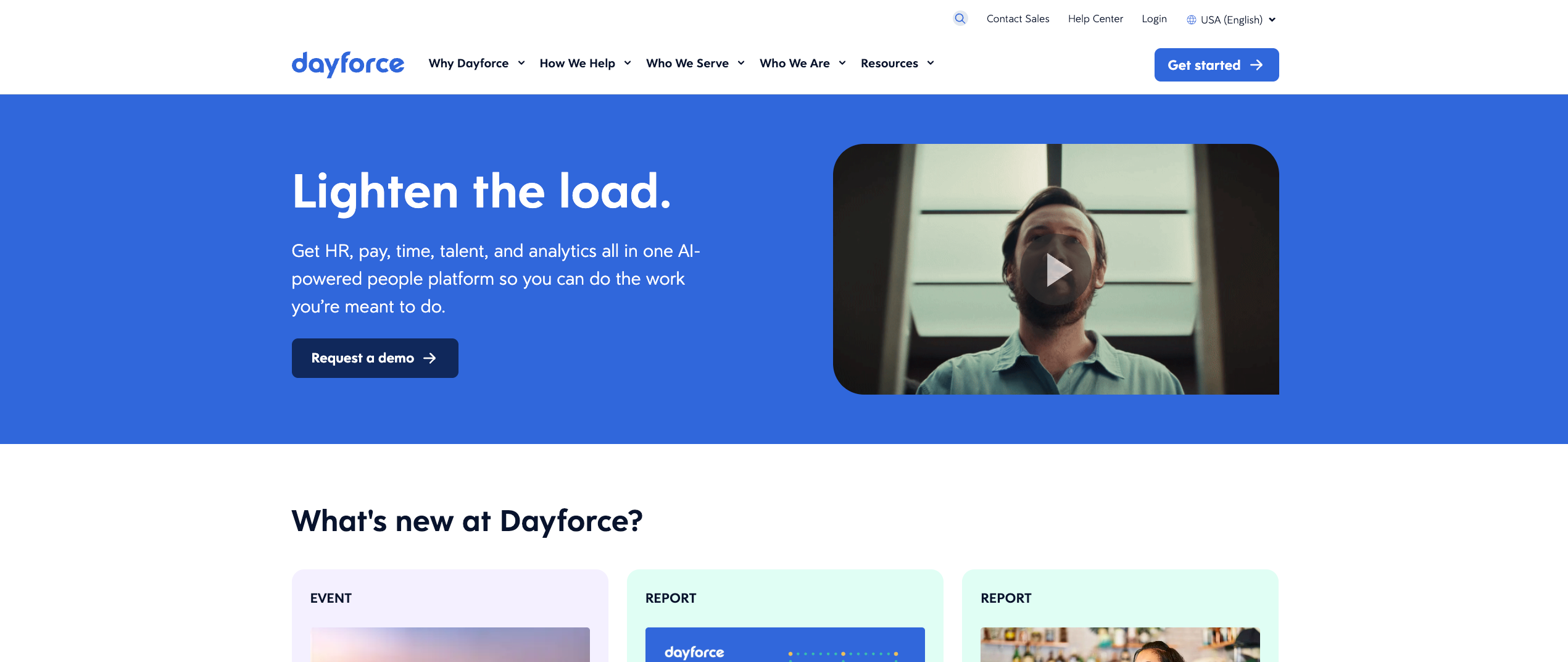
Every platform comparison starts with the same question: what problem was this built to solve? For Dayforce, the answer is enterprise human capital management at scale, with a specific emphasis on real-time data accuracy across every HR function.
From Ceridian to Dayforce: A Platform Built on a Single Data Model
Originally developed by Ceridian, Dayforce launched as one of the first HCM platforms built on a continuous calculation engine rather than the batch processing model most legacy HR systems used. That architectural choice, processing payroll and workforce data in real time rather than at set intervals, remains its most distinctive technical advantage today.
Named a Gartner Magic Quadrant Leader for Cloud HCM Suites for six consecutive years through 2025, and ranked in the Forrester Wave Q4 2025 for HCM solutions, Dayforce serves organizations across retail, healthcare, manufacturing, financial services, and professional services globally.
In late 2025, it launched Dayforce AI Workspace, a collaboration environment where HR teams and AI work alongside each other on staffing recommendations, compliance checks, and workforce planning.
The platform operates as a single unified suite covering:
- Core HR: Employee records, org management, onboarding, and self-service workflows
- Continuous payroll: Real-time tax calculation, multi-country processing across 200+ countries, garnishments, and direct deposits
- Workforce management: Staff scheduling, time tracking, labor forecasting, absence management, and shift bidding
- Benefits administration: Open enrollment, benefits reporting, and ACA compliance
- Talent management: Built-in ATS, performance reviews, learning management, succession planning, and compensation planning
- Analytics and reporting: Over 300 pre-built reports, AI-driven forecasting, and real-time workforce intelligence
- Dayforce Wallet: On-demand pay access for workers, similar in concept to Nowsta’s Instant Pay feature
Who Dayforce Is Built For
Dayforce targets mid-to-large enterprises with 500 to 10,000+ employees that need a unified human capital management platform connecting HR, payroll, and workforce management without data moving between disparate systems. Industries that derive the most value from its depth include:
- Healthcare organizations managing 24/7 scheduling with credential and compliance requirements
- Retail and manufacturing companies with complex shift rules, multi-location compliance, and high headcounts
- Financial services and professional services firms needing tight payroll accuracy and audit trails
- Multinational companies running global payroll across multiple jurisdictions
Where Dayforce consistently struggles is with small businesses and lean operations that need speed over sophistication. Multiple verified reviews note the platform “wasn’t able to keep up” as companies grew beyond basic needs and into more complex workflows, or conversely, was simply too heavy for teams that needed fast deployment and minimal configuration.
Related read:What Is Workforce Management Software?
Where Dayforce’s WFM Capabilities Land for Shift-Based Operations
This is the section that matters most for catering companies, event operators, and staffing agencies evaluating the Nowsta vs Dayforce decision. Dayforce has genuine workforce management tools. But how they perform operationally for shift-heavy businesses is a different question from how they perform on a feature checklist.
What Dayforce’s WFM Module Actually Does
Dayforce’s workforce management layer includes demand-based staff scheduling, time tracking with geofenced mobile clock-in, shift bidding, absence management, and labor cost forecasting. Capterra describes it as able to “surface real-time attendance status, timesheet anomalies, and shift readiness” while helping managers act quickly on staffing issues.
That is meaningful functionality, and for a retail chain managing 500 employees across 20 stores, it integrates cleanly with the payroll and compliance data already living in the platform.
The practical limitations emerge at the operational level, specifically for event-driven, contingent, and agency-managed workforces:
- No native vendor management. Managing staffing agencies, tracking agency worker performance, or reconciling agency invoices requires workarounds or third-party integrations. Dayforce was built around direct employment relationships, not the hybrid direct-plus-agency model that catering, events, and hospitality operations depend on
- Complex configuration for shift-based environments. Multiple users flag that setting up scheduling rules, shift patterns, and compliance workflows requires significant time and often specialist knowledge. One Capterra reviewer noted that configuration “can be time-consuming, especially for organizations implementing multiple modules.”
- Reporting requires technical skill. Building custom reports in Dayforce is consistently flagged as unintuitive for non-technical users, which means operations managers who need quick labor cost views often need workarounds
- Implementation before value. The platform delivers its best results when fully configured, but that configuration takes months. For a catering company facing peak season in 10 weeks, that timeline is a real operational problem
How Nowsta Approaches the Same Problem
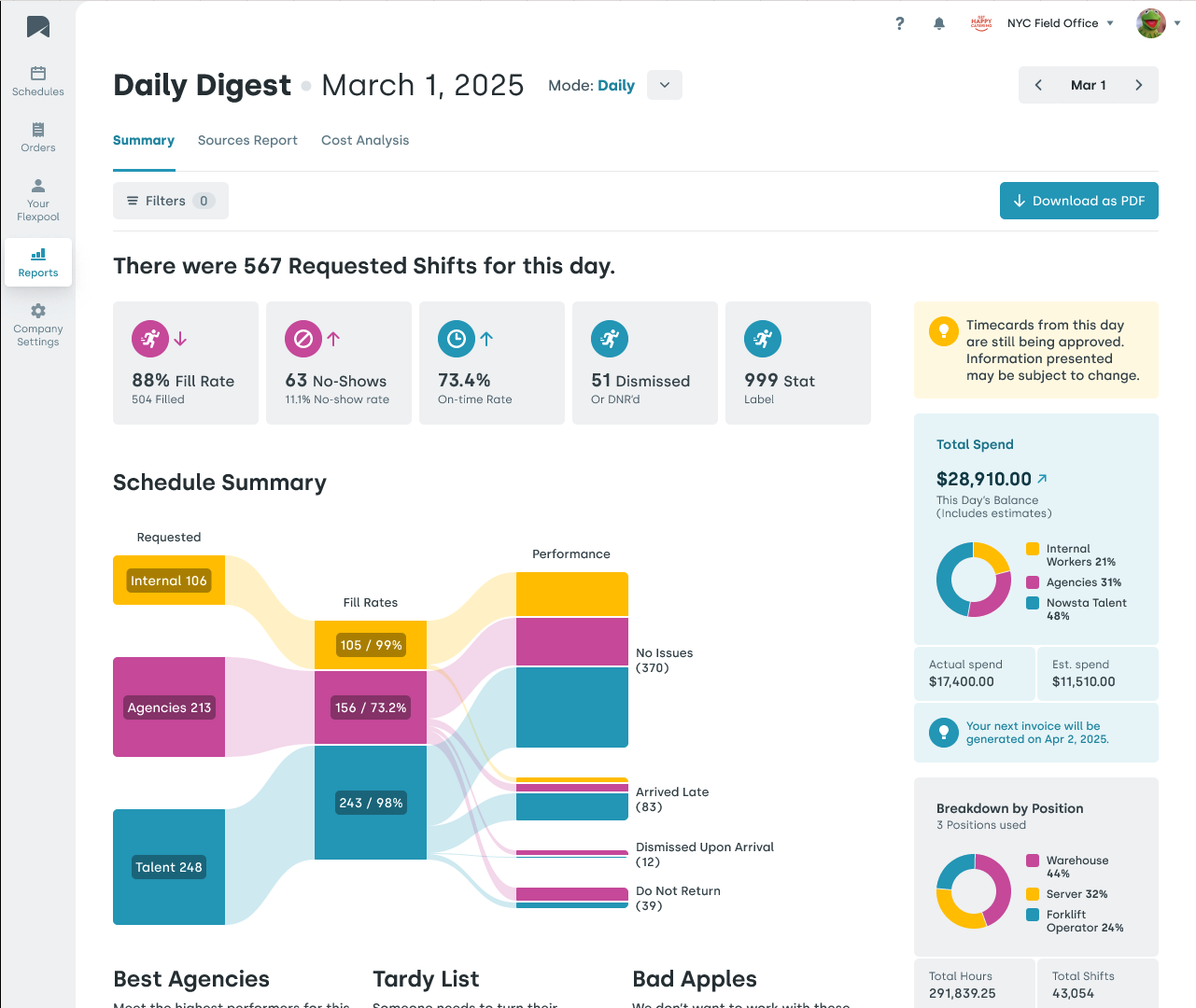
The platform approaches workforce management from the operational floor up. Rather than connecting scheduling to a broader HCM suite, it starts with the shift as the central unit of work and builds every feature around that reality.
Managers view events, required headcounts, available workers, and projected labor costs on a single page simultaneously. Workers receive shift requests, confirm availability, and clock in with GPS verification through a mobile app that requires no configuration or training to start using. Staffing agencies are managed directly within the platform, with performance ratings, spend tracking, and invoice reconciliation built in.
| WFM Capability | Nowsta | Dayforce |
|---|---|---|
| AI-powered staff scheduling | Yes, purpose-built | Yes, as part of the WFM module |
| GPS-verified attendance | Yes, native mobile | Yes, geofenced clock-in |
| Real-time no-show alerts | Yes, automated | Available with configuration |
| Vendor/agency management | Yes, built-in | Not natively supported |
| Shift bidding | Yes | Yes |
| Labor cost forecasting | Yes, event-level | Yes, enterprise-level |
| Time tracking | Yes, mobile-first | Yes, multiple methods |
| Contingent workforce tools | Yes | Limited |
| Configuration complexity | Low | High |
| WFM tools available from day one | Yes | After implementation |
Read more:Real-Time Workforce Visibility for Event Businesses
Implementation Length and What That Means Operationally
Most comparison articles treat implementation as a footnote. For shift-based operations, it is one of the most operationally significant factors in the entire decision.
Dayforce: Months of Work Before Day One
Dayforce implementations are resource-intensive by design. The platform’s depth is its selling point, but that depth requires significant configuration before it delivers value. Based on industry data and user reports:
- Standard mid-market implementation: 3 to 6 months for core modules
- Full-suite enterprise deployment: 6 to 12 months or longer for organizations with complex payroll, multi-country compliance, or significant data migration requirements
- Dedicated resources required: Internal project leads, HR administrators, and often external consultants to manage configuration, data migration, and testing
User reviews paint a consistent picture of the implementation experience. One Capterra reviewer described it as “expensive on-boarding” that required budgeting “accordingly.” Another noted that “integration feeds took significant time to create” and that the process required specialist involvement throughout.
The Dayforce website itself acknowledges that setup “can be time-consuming, especially for organizations implementing multiple modules or migrating payroll data.” That is an honest disclosure that buyers should take seriously when evaluating timelines against operational needs.
For a catering company heading into peak events season, or an event staffing agency needing to onboard a scheduling system before summer, a 6-month implementation is not just expensive. It is operationally disqualifying.
Nowsta: Operational Within Weeks
The platform was designed for operations teams that need to work fast. There is no complex configuration project, no data migration marathon, and no specialist consultant requirement to get the system running. Most teams are scheduling, tracking attendance, and exporting payroll data within weeks of starting.
The design principle is practical: tools that require months of setup before delivering value are tools that operations managers stop trusting. Nowsta’s approach, minimal training with immediate utility, reflects a deliberate choice to prioritize operational speed over feature depth.
Scratch Gourmet Catering is a good example. They modernized their entire staffing operation without a lengthy transition period. Read the full case study here to see how the implementation actually went.
Implementation Side-by-Side
| Factor | Nowsta | Dayforce |
|---|---|---|
| Time to go-live | Weeks | 3 to 12 months |
| Implementation cost | Minimal | $50,000 to $120,000+ |
| Internal resources required | Low | Moderate to high |
| External consultants needed | No | Often yes |
| Training requirement | Minimal | Significant |
| Value delivered from week one | Yes | After configuration |
| Mobile workers productive immediately | Yes | After setup |
Related read: How Large Organizations Transition Off Spreadsheets
The Verdict: Full-Suite HCM vs Purpose-Built WFM
Four articles into this series, covering Workday, UKG, ADP, and now Dayforce, a clear pattern has emerged. Every enterprise HCM platform in this category offers workforce management. None of them were designed for it the way Nowsta was.
That distinction matters depending entirely on what your operation actually needs.
Choose Dayforce if:
- You need a single platform connecting HR, payroll, benefits, talent, and workforce management across a mid-to-large structured organization
- Your workforce spans multiple countries, and you need global payroll with automated compliance across 200+ jurisdictions
- You have dedicated HR staff and implementation resources to invest in a 6 to 12-month configuration project
- Your industries of focus include healthcare, manufacturing, or large-scale retail, where Dayforce’s scheduling depth and compliance automation deliver clear ROI
- You want Dayforce Wallet for on-demand pay access integrated directly with payroll, without a third-party tool
Choose Nowsta if:
- Your operation runs on shifts, events, and contingent labor, where scheduling speed and attendance accuracy are daily operational priorities
- You manage staffing agencies alongside direct hires and need vendor performance tracking, spend visibility, and invoice reconciliation in one place
- You need a workforce management tool that is operational within weeks, not months, and requires minimal training to use from day one
- You are evaluating Nowsta alternatives or Dayforce alternatives specifically for the WFM layer and want a purpose-built solution rather than a module within a larger suite
- Your people range from hourly workers in catering to contingent event staff, and you need a platform that tracks time, manages attendance, and connects to payroll accurately without enterprise complexity
Nowsta and Dayforce are not really competing for the same buyer. Dayforce wins when the priority is a unified human capital management system for a structured, salaried, or multi-country workforce. Nowsta wins when the priority is operational precision for shift-based teams that need to fill, manage, and pay a dynamic workforce without a six-month warmup.
OTH Company scaled nationwide event staffing operations using Nowsta without the overhead of an enterprise HCM. That is the use case this platform was designed for.
Also worth reading:The Workforce Intelligence Era and 7 Ways AI Is Revolutionizing Workforce Management
Full-Suite or Right-Fit? For Shift-Based Teams, Nowsta Answers That Question.
Dayforce is a genuinely powerful HCM platform. But power without fit is just overhead. If your workforce runs on shifts and your managers are filling open roles the morning of an event, the platform built for global succession planning is solving a problem you do not have.
Key takeaways:
- Dayforce is a full-suite HCM platform best suited for mid-to-large enterprises with structured, complex HR needs across multiple locations or countries
- Nowsta is purpose-built for hourly, shift-based, and contingent teams in catering, events, hospitality, staffing, and QSR
- Dayforce implementation takes 3 to 12 months; Nowsta is operational within weeks
- Dayforce has no native vendor or staffing agency management; Nowsta has it built in
- G2 lists Dayforce as the top Nowsta alternative, making this a direct and relevant comparison for operators actively evaluating both
If your operation lives and dies by the shift, Nowsta gives you the scheduling speed, attendance accuracy, and payroll integration to manage it without six months of setup. Schedule a demo and see how fast purpose-built actually feels.
FAQs
Who is Dayforce’s biggest competitor?
Dayforce’s biggest competitors are Workday, UKG Pro, ADP Workforce Now, SAP SuccessFactors, and Rippling. For organizations specifically evaluating workforce management tools for shift-based and contingent teams, Nowsta is also a strong alternative that outperforms Dayforce on scheduling speed, ease of use, and time-to-value.
Who uses Nowsta?
Nowsta is used by operations-driven businesses in catering, events, hospitality, staffing, hotels, QSR, and warehousing. Customers include Continental Services, One World Catering, Simply Fresh Events, Footers Catering, Top Notch Staffing, and The Pier Sixty Collection. Most are companies managing hourly, shift-based, and contingent workforces where scheduling and attendance accuracy directly impact operations.
What is Dayforce called now?
Dayforce was previously known as Ceridian Dayforce, named after its parent company, Ceridian HCM. In 2024, Ceridian rebranded the platform simply as Dayforce and renamed the company accordingly. The platform itself, a unified HCM suite covering HR, payroll, workforce management, benefits, and talent, remained unchanged. The company trades on the NYSE and TSX under the ticker symbol DAY.
Which is better, ADP Workforce Now or Dayforce?
It depends on your needs. ADP Workforce Now is better for small to mid-sized businesses that prioritize payroll accuracy, transparent HR administration, and faster implementation. Dayforce is better for larger, more complex organizations needing unified human capital management with real-time payroll processing and global compliance. For shift-based teams that need operational workforce management above all else, both have gaps that a purpose-built platform like Nowsta fills more effectively.