Your labor forecast is only as good as the data behind it. And if that data lives in a spreadsheet built on gut instinct and last year’s patterns, you’re already behind. Businesses using automated forecasting tools achieve up to 25% improvement in scheduling accuracy and reduce overtime costs by 20%. That’s not a marginal upgrade. That’s a different operating model.
This article breaks down exactly how AI is reshaping the way enterprises predict labor demand and build smarter schedules.
Here’s what we’ll cover:
- What AI-powered labor forecasting actually looks like in practice
- How predictive models use historical and real-time data to anticipate demand
- The specific scheduling problems AI solves (and where it still needs humans)
- How demand forecasting connects to overtime control and compliance
- Real ROI benchmarks from enterprises that have made the switch
- What to look for when evaluating AI scheduling platforms
Nowsta is one of the platforms leading this shift. Its AI-powered scheduling engine combines demand forecasting, talent intelligence, and real-time labor analytics. It helps operations teams move from reactive scheduling to proactive workforce orchestration.
AI Forecasting in Practice
A demand forecasting engine pulls in historical sales data, foot traffic patterns, seasonal trends, and local events. It runs that data through machine learning algorithms to predict how many workers you’ll need, by role, by location, by hour. Then it builds the schedule automatically, factoring in employee preferences, certifications, labor laws, and overtime thresholds.
The whole process takes minutes. Not days.
What the System Considers
Traditional shift planning asks: Who’s available? AI scheduling asks a much bigger question:
- What does demand look like? Using historical data and real-time data, AI models forecast labor needs down to 15-minute intervals for high-volume operations.
- Who’s the best fit? Intelligent algorithms match workers to shifts based on skills, reliability scores, proximity, and compliance requirements.
- What will it cost? Before a single shift publishes, the system calculates projected labor costs and flags anything that pushes past budget or overtime limits.
- What could go wrong? Predictive analytics identify risk factors like historically high callout days or unexpected events that could disrupt staffing levels.
This isn’t theoretical. Major retailers using AI-based workforce scheduling have reduced labor expenses by 7-9% while improving customer satisfaction scores by nearly 6 percentage points. Those systems forecast labor requirements with roughly 95% accuracy.
Pro tip: The value of ai scheduling isn’t just in building schedules faster. It’s in building smarter schedules that account for variables no spreadsheet can process simultaneously.
Nowsta’s demand forecasting engine does exactly this. It combines AI-driven demand signals with talent intelligence to generate optimized schedules that balance operational efficiency, labor costs, and employee satisfaction in a single workflow.
Predictive Models and Demand Signals

The power of artificial intelligence in workforce planning isn’t that it works harder. It’s that it sees more.
Human managers build schedules based on what they remember. Last week was busy. Last Tuesday was slow. The holiday weekend usually needs extra coverage. That’s valuable experience. But it’s limited to what one brain can recall and process.
Machine learning algorithms don’t have that limitation. They analyze thousands of data points simultaneously to forecast labor needs with a level of precision that manual work simply can’t match.
The Data That Drives More Accurate Forecasts
AI models pull from two categories of input:
Internal data sources:
- Historical sales and transaction volume by hour, day, and season
- Past employee behavior, like attendance patterns, shift swaps, and no-show rates
- Labor costs per shift, per location, per role
- Service levels and customer experience metrics tied to staffing decisions
External data sources:
- Weather forecasts that affect foot traffic and demand patterns
- Local events like concerts, conventions, or sporting events
- Holiday calendars and regional observances
- Even economic indicators that shift consumer spending behavior
The result is a demand forecast that doesn’t just look backward. It looks forward, incorporating signals that traditional workforce management tools completely ignore.
Why This Matters for Staffing Decisions
When you can forecast labor demand with accuracy, you can plan ahead instead of reacting. That means:
- Fewer overstaffed shifts bleeding money during slow periods
- Fewer understaffed shifts hurting service quality and burning out your team
- Balanced schedules that respect work-life balance while meeting business needs
- Actionable insights that help managers plan smarter instead of guessing
Companies using AI-based scheduling in sectors like telecommunications and energy have reduced labor costs by 10-15% and automated up to 50% of their forecasting and staffing processes. That’s the difference between a workforce strategy built on data and one built on hope.
What AI Solves (and Where Humans Win)
AI is exceptionally good at repetitive tasks that require processing massive amounts of data quickly. It’s less good at the nuanced, messy, deeply human parts of workforce management. Knowing the difference is what separates smart implementation from wasted investment.
Problems AI Solves Better Than Humans
- Optimizing schedules at scale. When you’re managing hundreds of employees across multiple locations, no human manager can simultaneously weigh availability, skills, labor costs, compliance risks, and demand patterns for every shift. Advanced algorithms do it in seconds.
- Catching costly errors before they happen. AI flags overtime violations, union rules conflicts, and scheduling gaps the moment they appear. No manual intervention required.
- Adaptive scheduling in real time. When someone calls out at 5 AM, an ai powered system identifies the best replacement instantly, factoring in proximity, qualifications, and cost. The shift gets filled before the gap creates a service problem.
- Eliminating bias in shift distribution. Dynamic scheduling assigns shifts based on objective criteria, not who a manager happens to think of first. That leads to higher employee satisfaction and fewer grievances.
Where Human Managers Still Matter
- Reading the room. An employee going through a tough time might need a lighter schedule. AI won’t pick up on that unless someone flags it. Human connection matters.
- Navigating complex team dynamics. Two employees who don’t work well together, a new hire who needs mentoring on specific shifts, or a team that thrives under certain leadership. These are complex tasks that require human oversight and judgment.
- Strategic workforce decisions. Should you hire more full-time staff or lean into contingent labor supply? That’s a workforce strategy question that demands context AI doesn’t have.
- Building culture. Engaged employees don’t just want fair schedules. They want to feel valued. That takes leadership, not an algorithm.
The smartest ai driven solutions don’t replace human managers. They free them from the manual work that eats up their day, so they can focus on the stuff that actually requires a human brain.
Forecasting, Overtime, and Compliance
Here’s the connection most operations teams miss: demand forecasting isn’t just about staffing levels. It’s your first line of defense against overtime blowouts and compliance violations.
When you can’t accurately forecast demand, every downstream decision suffers. You overstaff and waste money. You understaff and push workers into overtime. You violate predictive scheduling laws because you changed the schedule last-minute. The root cause is the same: you didn’t see it coming.
How Accurate Forecasting Prevents Overtime
Overtime spirals start when coverage gaps appear unexpectedly. AI-powered forecasting prevents this by:
- Predicting demand surges before they hit. If historical data and local events suggest next Saturday will be 40% busier than average, the system builds that into the schedule proactively. No last-minute scramble. No overtime premiums.
- Flagging employees approaching thresholds. Before a shift publishes, the platform shows exactly which employees are nearing 40 hours. Managers can redistribute shifts to optimize labor costs without sacrificing coverage.
- Reducing no-shows through predictive scheduling. When schedules are posted earlier and respect employee preferences, attendance improves. Fewer no-shows means fewer emergency overtime fills.
How It Protects Against Compliance Risks
Labor laws are becoming more complex, not simpler. Predictive scheduling ordinances in cities like New York, Chicago, and San Francisco require advance notice, premium pay for last-minute changes, and detailed records.
A scheduling platform with built-in compliance logic handles this automatically:
- Enforces advance notice requirements based on jurisdiction
- Blocks shifts that violate meal break, rest period, or overtime rules
- Maintains audit-ready records of every schedule change and the reason behind it
- Adapts to new labor laws without requiring manual updates
Pro tip: The fastest way to save time on compliance is to stop treating it as a separate process. When it’s embedded into your scheduling platform, it happens automatically with every shift.
ROI Benchmarks Worth Knowing

Talk is cheap. Let’s look at the numbers enterprises are actually seeing after switching from manual or legacy scheduling to AI-powered workforce solutions.
The Hard ROI
| Metric | Typical Impact |
|---|---|
| Scheduling time reduction | 40-80% less time spent building schedules |
| Labor cost reduction | 7-15% decrease in total labor spend |
| Overtime cost reduction | 20-35% decrease in unplanned overtime |
| No-show reduction | 15-28% improvement with mobile access and reminders |
| Compliance violation reduction | Significant drop in penalties through automated rule enforcement |
| Employee turnover improvement | 5-15% reduction when schedules become predictable and fair |
Organizations at full maturity with AI scheduling solutions report ROI ratios of 300-500%, meaning a 3 to 5x return on their initial investment. The compounding effect of reduced labor costs, fewer errors, and improved retention drives value that grows over time.
The Soft ROI Nobody Measures (But Should)
Beyond the spreadsheet, there are gains that directly affect workforce performance:
- Higher employee engagement. When workers have mobile access to schedules, can request shift swaps easily, and see fair distribution in action, trust builds. That trust translates to lower absenteeism and stronger retention.
- Better customer experience. Properly staffed shifts produce better service quality. In today’s labor market, that’s a differentiator.
- Manager productivity. When human managers aren’t buried in manual work, they focus on coaching, problem-solving, and strategic initiatives. That’s where their value compounds.
One major home improvement retailer using AI scheduling reported annual labor savings of $112 million across more than 1,900 locations while simultaneously improving employee satisfaction through more predictable scheduling.
The break-even point for most mid-sized enterprises? Typically, between months 7 and 10 after implementation.
Evaluating AI Scheduling Platforms
Not all employee scheduling software is the same. Some platforms bolt on “AI” as a marketing label while still relying on basic templates under the hood. Here’s how to separate real intelligence from surface-level automation.
The Non-Negotiable Features
When evaluating a scheduling platform, these capabilities should be standard, not premium add-ons:
- True demand forecasting. The platform should analyze historical data, external signals, and real-time data to forecast labor needs by role, location, and time interval. If it only replicates last week’s schedule, it’s not AI. It’s copy-paste.
- Integration capabilities. Your scheduling tool needs to connect seamlessly with payroll, hr systems, time tracking, and talent management tools. Disconnected data creates data quality problems that undermine every forecast.
- Compliance automation. The system should enforce labor laws, union rules, and company policies automatically during schedule creation, not after.
- Mobile access for employees. Workers should be able to view schedules, request shift swaps, submit availability, and receive notifications from their phones. This is table stakes for employee engagement in today’s labor market.
- Actionable insights, not just dashboards. Look for platforms that surface recommendations, not just reports. The key benefits of AI come from turning data into staffing decisions, not just charts.
Red Flags to Watch For
- The vendor can’t explain how their AI actually works (no natural language processing, no machine learning, no predictive analytics under the hood)
- Limited or no ability to incorporate external factors like weather or local events
- Requires heavy manual intervention for basic scheduling tasks
- No transparent ROI data or customer benchmarks
What Future Trends Demand
As workforce solutions evolve, the platforms that win will offer adaptive scheduling that learns from every shift, deeper talent intelligence for contingent and hourly teams, and the ability to plan ahead across locations and seasons, not just next week.
Nowsta is built for this moment. It combines AI-powered scheduling, demand forecasting, talent intelligence, and real-time labor analytics in a single platform with strong integration capabilities across payroll and HR systems.
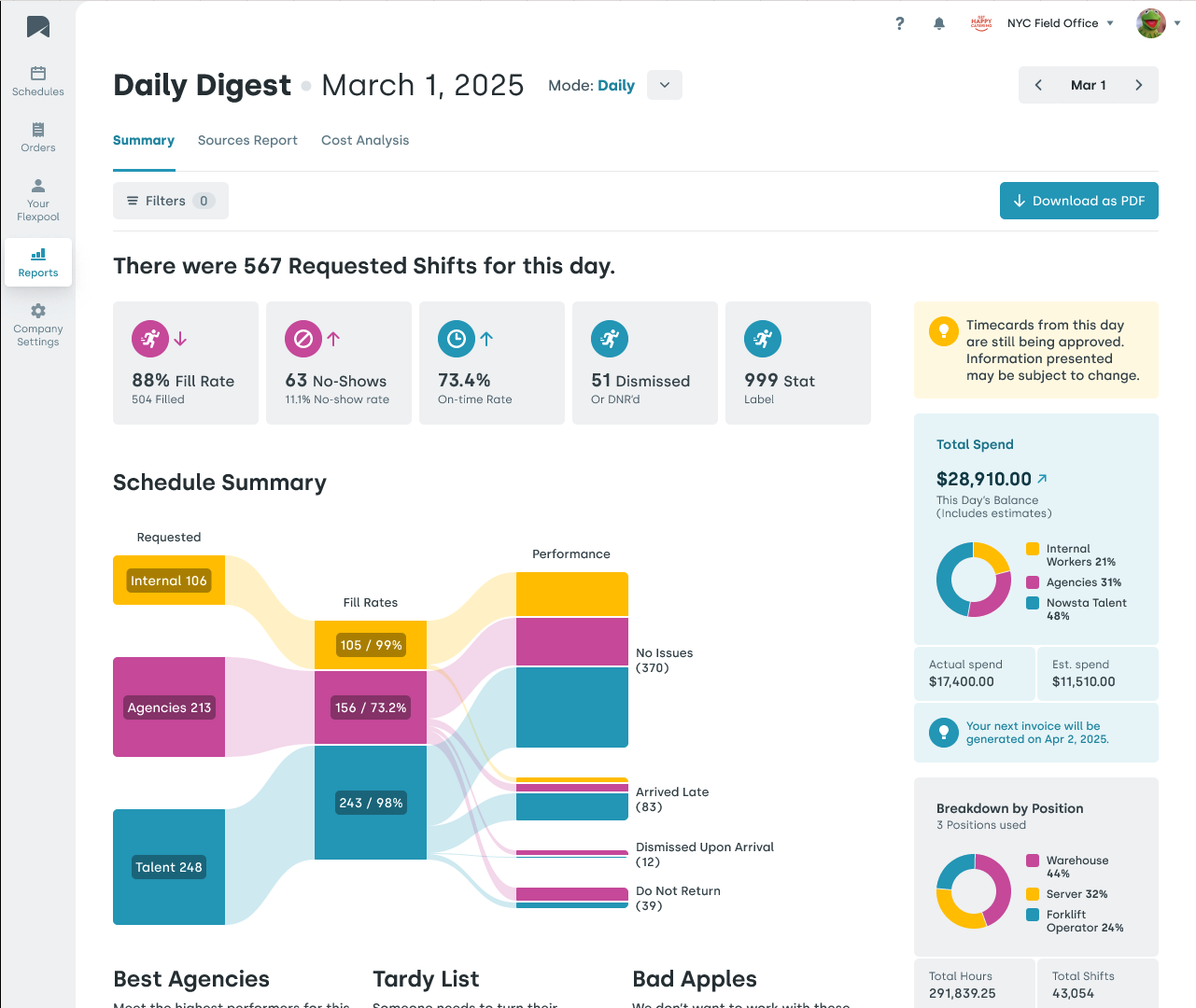
For operations teams managing hourly and contingent workers in industries like catering, events, QSR, and staffing, it’s the workforce management platform that turns data into smarter schedules and reduced labor costs.
Make the Leap to Workforce Intelligence With Nowsta
Scheduling got you this far. But the enterprises pulling ahead in 2026 aren’t just filling shifts. They’re using workforce intelligence to predict demand, optimize labor spend, and make smarter decisions before problems surface.
Here’s what to remember:
- Traditional scheduling only answers “who works when,” not “who should work when.”
- Workforce intelligence turns labor data into strategic, real-time decision-making
- AI-powered forecasting eliminates reactive scrambling and reduces human error
- Talent intelligence helps you source, evaluate, and retain the right people faster
- The ROI of workforce orchestration compounds as you scale locations and headcount
- Companies that treat workforce data as a strategic asset gain a lasting competitive edge
Nowsta was purpose-built for this evolution. From AI-powered scheduling and talent intelligence to real-time labor analytics and seamless payroll integration, it gives operations teams the visibility to move from reactive to strategic.
Curious what AI-powered scheduling looks like in practice? Nowsta uses demand forecasting and talent intelligence to fill the right shifts with the right people. Schedule a demo and see what workforce intelligence looks like in action.
FAQs
What Is the Difference Between Scheduling and Workforce Intelligence?
Scheduling focuses on assigning people to shifts. Workforce intelligence goes further by analyzing labor patterns, forecasting demand, and surfacing insights that drive smarter staffing decisions. Think of scheduling as the what, and workforce intelligence as the why and what’s next. It’s the difference between filling shifts and optimizing your entire operation.
How Are Contact Centers Using Workforce Intelligence?
Contact centers were among the first to adopt workforce intelligence because staffing accuracy directly impacts service levels and costs. These environments use AI tools to forecast call volume, auto-generate schedules based on predicted demand, and adjust staffing in real time when volume spikes. For contact centers managing hundreds of agents across multiple shifts, this level of precision prevents both overstaffing and burnout.
Can Workforce Intelligence Reduce Human Error in Scheduling?
Yes, significantly. Manual scheduling introduces human error at every stage, from miscounting hours to overlooking compliance rules. Workforce intelligence platforms automate these calculations and flag conflicts before schedules go live. The result is fewer payroll mistakes, fewer compliance violations, and fewer last-minute scrambles caused by preventable oversights.
Is Workforce Intelligence Only for Large Enterprises?
Not anymore. While early workforce intelligence platforms targeted large contact centers and Fortune 500 companies, the technology has become accessible to mid-sized and growing businesses.
Platforms like Nowsta are designed for organizations with hourly and contingent workforces across industries like catering, events, QSR, and staffing. If you manage shift-based teams and need better visibility into labor costs and performance, workforce intelligence applies to you.