When overtime costs spike, the instinct is always the same: cut shifts or trim headcount. But what if the overtime problem has nothing to do with how many people you have, and everything to do with how you’re deploying them?
Industry data shows overtime rates have increased by more than 12% since 2022. For shift-based operations running multiple events or locations simultaneously, that’s not a rounding error. That’s a structural budget problem hiding inside a scheduling problem.
Here’s what this article covers:
- Why overtime keeps happening even when you’re fully staffed
- The root causes most operations never actually fix
- How smarter scheduling eliminates overtime without touching headcount
- The role of cross-training, demand forecasting, and shift design
- Real-time monitoring tools that catch overtime before it triggers
- How to build an overtime policy that actually holds
- What the data says about overtime costs and how to measure the reduction ROI
The platform that ties all of this together, cleanly, is Nowsta. Its AI-powered scheduling and real-time overtime alerts are built specifically for the kind of shift-based, high-volume environments where overtime bleeds quietly into every payroll cycle.
Why Overtime Keeps Happening Even When You’re Fully Staffed
Full headcount doesn’t mean zero overtime. That’s a hard lesson most operations learn only after seeing it show up in payroll, repeatedly, without a clear explanation.
The assumption is that overtime happens when you don’t have enough people. Sometimes that’s true. But more often, excessive overtime happens when you have the right number of people scheduled in the wrong configuration. Too many employees on a slow Tuesday. Not enough coverage on a busy Saturday night. The headcount is there. The distribution is off.
The Three Most Overlooked Triggers
- Shift structure that doesn’t match demand curves: When every shift looks the same regardless of the event load that day, someone always ends up in extra hours. Hourly workers absorb the slack at the end of the shift, and their overtime hours start climbing.
- Unexpected absences with no coverage system: One no-show forces another worker into extra hours to maintain service levels. Without a bench or a real-time fill process, that’s the only lever available. And it’s expensive.
- Concentration of skills in too few people: When only two people on the roster know how to run a specific role, those two employees work overtime constantly during busy seasons and high-demand periods. Everyone else clocks out on time. The imbalance is structural, not situational.
If the same individual workers keep logging most overtime week over week, that’s not a dedication problem. It’s a scheduling architecture problem. Fix the structure, not the person.
The Root Causes Most Operations Never Actually Fix

Knowing overtime is expensive isn’t the same as knowing why it keeps happening. Most operations treat the symptom. Very few fix the cause.
Here are the root causes that consistently drive unnecessary overtime across event and staffing operations:
Scheduling Employees Without Demand Data
Building a schedule based on what worked last month, or worse, gut feel, is a reliable recipe for routine overtime. Customer demand fluctuates. Events vary in size, complexity, and duration. When staffing levels don’t flex with demand, you either overstaff quiet periods or understaff peak ones. Either way, the labor budget suffers.
No Real-Time View of Hours Worked
Common culprits behind excessive overtime include failure to anticipate demand, outdated workforce management systems, and the lack of real-time operational visibility.
When frontline managers can’t see who’s approaching the overtime threshold during a shift, they can’t act until it’s too late. The actual hours are already locked in by the time payroll runs. That’s not management. That’s documentation of damage already done.
Forced Overtime as a Default Gap-Fill
Forced overtime is what happens when there’s no plan B. No bench. No cross-trained staff. No system to broadcast open shifts to available workers. The result is that the same reliable core team keeps getting tapped, hours a week stack up, and employee morale quietly erodes.
Poor Overtime Visibility Across the Workforce
Industry best practices suggest overtime should not exceed 3 to 5% of total labor costs for most businesses. Most operations have no idea where they’re tracking. Without tools to identify overtime patterns by role, shift, or event type, you can’t make informed decisions about where to intervene.
| Root Cause | What It Looks Like in Practice |
|---|---|
| No demand forecasting | Same shift structure regardless of event size |
| No real-time hour tracking | OT discovered at payroll, not during the shift |
| Skill concentration in a few workers | Same people consistently hitting 50+ hours |
| No fill system for absences | Existing staff covers gaps at 1.5x rate |
| No overtime policy enforcement | Managers approve OT without budget visibility |
How Smarter Scheduling Eliminates Overtime
Here’s the key insight: you don’t reduce overtime by cutting shifts. You reduce it by building schedules that match actual demand with precision, so coverage is right-sized from the start.
Match Staffing Levels to Demand Curves
Not all hours within an event are equal. Setup, peak service, and breakdown each require different staffing levels. A schedule that treats all three the same will almost always generate overtime at the transitions.
Smarter employee scheduling means:
- Staggering start times so staff arrive when the work actually begins
- Building shorter, targeted shifts for lower-intensity periods
- Avoiding the default 8-hour block when the actual work window is 5 hours
This alone can eliminate a significant portion of unnecessary labor costs without touching headcount.
Use Historical Data to Stop Reacting
Every event you’ve run is a data set. Predictive models analyze historical data, including event schedules, seasonality, and local trends, to forecast future staffing needs, allowing operations to avoid both understaffing during peak periods and overstaffing during slower times.
When you use historical data to build future schedules, you stop reacting to demand and start anticipating it. Fewer surprises. Fewer last-minute calls. Less increasing overtime during peak periods because the staffing was right from the start.
Build Float Into Your Roster, Not Your Hours
Instead of relying on overtime to cover gaps, build a confirmed bench of available workers who can absorb demand spikes without pushing your core team into extra hours. This approach protects work-life balance for your most reliable staff and reduces the poor work-life balance cycle that drives employee turnover.
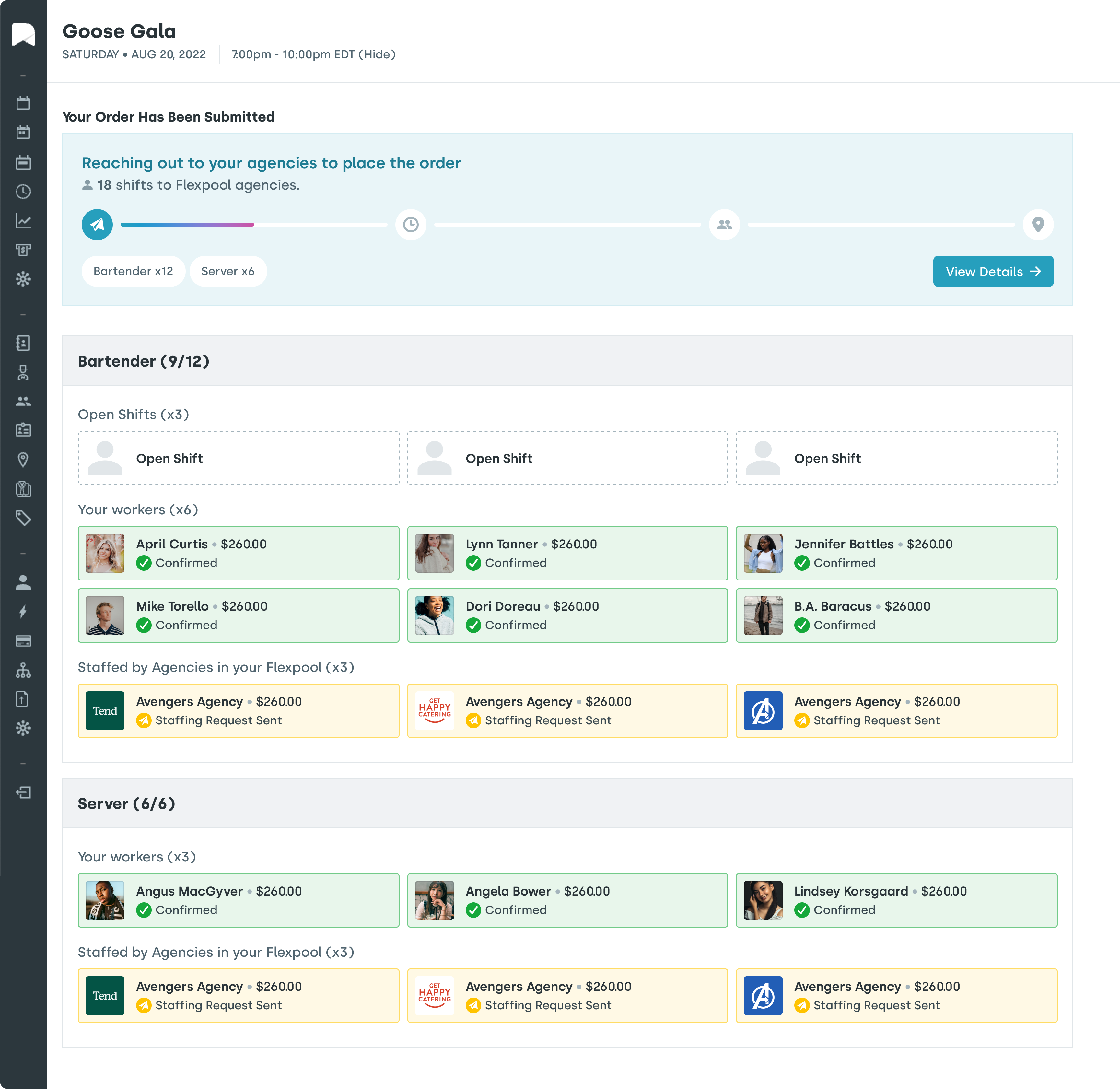
Nowsta’s AI-powered scheduling does exactly this, using demand forecasting to recommend optimal staffing levels per event while automatically flagging shifts where labor costs are projected to exceed budget before a schedule is even published.
Cross-Training, Demand Forecasting, and Shift Design
These three levers do more to reduce overtime than any policy ever will. Together, they address the structural reasons overtime happens in the first place.
Cross-Training: The Multiplier Effect
When you cross-train employees across multiple roles, the coverage math changes entirely. One worker who can perform multiple roles gives you flexibility that no amount of overtime can replicate.
In hospitality and events, having servers trained in bar service means you can pull from other departments during busy periods instead of scheduling an extra person “just in case.” This saves money and protects your strongest employees from bearing the full brunt of every busy shift.
Cross-train your roster with this approach:
- Identify the five roles that most frequently trigger overtime
- Build a cross-training plan that creates at least two qualified backups per role
- Track cross-training progress in your workforce platform so it’s visible when scheduling employees
The result is a core team that’s genuinely flexible, not just theoretically capable.
Demand Forecasting: Stop Scheduling Blind
Customer demand in event operations isn’t random. It follows patterns: seasons, event types, venue capacities, and day of week. When you feed that data into a forecasting model, the schedule that comes out is built on evidence, not instinct.
Capacity modeling using historical data to predict staffing needs three to six months ahead is one of the most effective ways to avoid overtime during busy seasons and predictable demand spikes.
For business owners running multiple events simultaneously, this is the difference between a labor budget that holds and one that blows out every busy month.
Shift Design: The Overlooked Variable
Most overtime problems live inside shift design decisions that nobody revisits. Common culprits:
- Shifts that start too early and create dead time before peak demand
- Shifts that don’t have defined end points, creating ambiguous overtime exposure
- Lack of staggered entry points to cover continuous operations without everyone hitting 40 hours at the same time
Flexible scheduling through staggered start times and role-specific shift lengths is one of the highest-impact, lowest-cost overtime reduction strategies available. No new hires required.
Real-Time Monitoring Tools That Catch Overtime Before It Triggers

Prevention is the only version of overtime management that actually saves money. Detection after the fact just documents how much you lost.
What Real-Time Monitoring Actually Does
The right labor tracking tools give frontline managers a live view of:
- Who is currently clocked in, and how many hours have they worked this week
- Which workers are approaching the overtime threshold right now, not at the end of the shift
- Where labor spend is tracking against the event budget in real time
- Which non-exempt employees are close to triggering overtime pay under the Fair Labor Standards Act
The Fair Labor Standards Act requires overtime pay at 1.5 times the regular hourly rate for hours worked beyond 40 in a week. For hourly workers, that clock runs continuously. Without a real-time view, managers don’t know they’ve crossed the threshold until payroll calculates it, which is always too late to course-correct.
Automated Alerts Change the Decision Window
The difference between catching overtime and paying for it comes down to when you find out. Automated alerts that fire when a worker hits 36 or 38 hours a week give managers a window to act, swap shifts, redistribute coverage, or pull from the bench before the cost is locked in.
Automated scheduling software like Nowsta builds these alerts directly into the scheduling workflow. Managers get notifications when workers are approaching thresholds. The platform flags are projected over time before a schedule is confirmed, not after a shift ends. That’s the kind of visibility that actually reduces labor costs rather than just tracking them.
GPS Clock-In: The Accuracy Layer
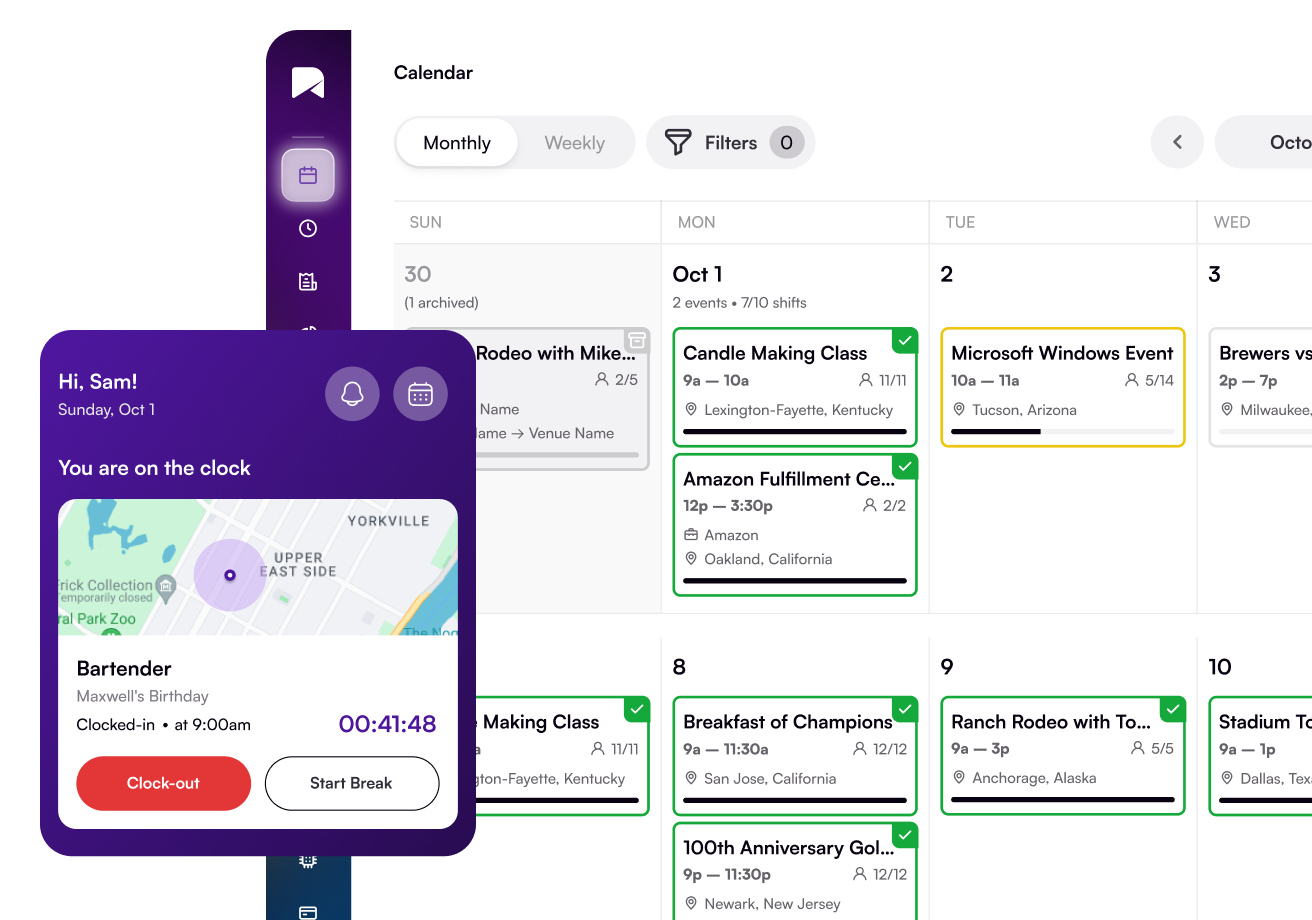
Labor tracking tools that rely on self-reported hours or manual data entry introduce error. GPS-enabled clock-in eliminates the guesswork. Actual hours worked are captured automatically, providing clean data for compliance with labor laws while also giving the clearest possible picture of where overtime is accumulating across your roster.
Nowsta’s time and attendance module combines GPS clock-in with automated overtime alerts and live budget dashboards, giving frontline managers and operations leaders a unified view of actual hours versus scheduled hours across every active event.
How to Build an Overtime Policy That Actually Holds
An overtime policy that lives in an employee handbook but never shows up in a real conversation is not a policy. It’s a document. Here’s how to build one that actually controls costs.
The Key Components of an Effective Policy
A working overtime policy needs to address five things clearly:
- Pre-approval requirements. All overtime hours require manager approval before they occur, not ratification after the fact.
- Weekly hour thresholds. Define the point at which overtime alerts trigger for non-exempt employees and salaried employees alike.
- Maximum work hours per shift and week. Set hard limits that protect against safety risks from fatigue while managing labor expenses.
- Accountability for exceptions. Document who approved overtime, why, and what the projected cost impact is.
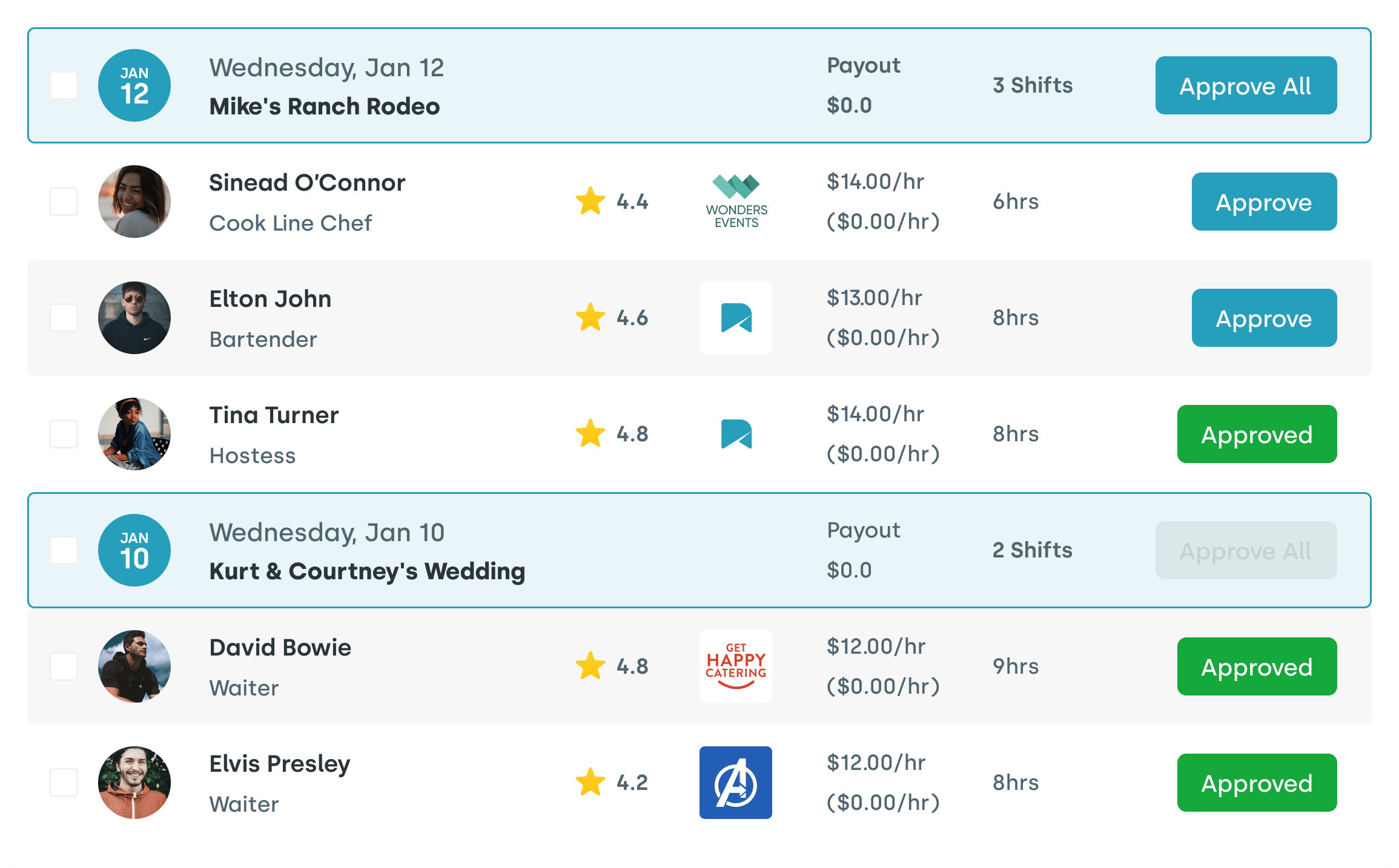
- Budget visibility. Every manager responsible for scheduling should see their labor budget in real time so overtime approval decisions are made with cost context, not in a vacuum.
Make It Visible, Not Just Written
An effective policy gets reinforced in onboarding, in shift briefings, and in the platform your team uses every day. When overtime pre-approval is built into the scheduling software rather than requiring a separate conversation, compliance improves naturally.
Nowsta’s platform enforces budget guardrails at the scheduling stage. If a manager tries to confirm a schedule that projects high labor costs due to overtime exposure, the system flags it. The policy becomes part of the workflow, not a separate document nobody reads.
Address the Culture of Routine Overtime
In many operations, too much overtime becomes normalized. Workers expect it. Managers rely on it. It hurt morale paradoxically in both directions: some workers want it for the pay, others burn out from it. Neither outcome supports a productive work environment.
Forcing employees to work overtime increases sick calls and absenteeism. Overtime should be something employees want, and when it’s forced to run the facility, it hurts morale and productivity.
The cultural fix starts with leadership making it clear that routine overtime is a system failure, not a sign of commitment.
What the Data Says About Overtime Costs and ROI
The business case for reducing overtime is straightforward. Here’s what the numbers actually say.
The True Cost of an Overtime Hour
Overtime isn’t just 1.5x base pay. The full overtime costs include:
- 1.5x base rate for all overtime pay under FLSA rules
- Increased payroll taxes on elevated earnings
- Higher workers’ compensation premiums tied to longer hours
- Productivity degradation as employee burnout reduces output per hour
- Elevated turnover risk as poor work-life balance drives employee turnover, adding recruitment and training costs on top of the labor spend
Every additional overtime hour adds premium pay without proportional productivity gains. Absenteeism spikes require last-minute reshuffling, often at the expense of efficiency.
What Reduction Actually Delivers
Companies that implement proper overtime reduction strategies typically see 15 to 20% overtime cost reduction within 60 to 90 days, with full benefits realized within six months.
For an operation spending $500,000 annually on labor, with 8% going to overtime, that’s $40,000 in overtime spend. A 15% reduction saves $6,000 in the first two months. A 50% reduction over six months saves $20,000 annually. That’s without touching a single shift or reducing headcount by a single person.
Here’s a simplified ROI model:
| Scenario | Annual OT Spend | Reduction | Annual Savings |
|---|---|---|---|
| Conservative (15%) | $40,000 | 15% | $6,000 |
| Moderate (30%) | $40,000 | 30% | $12,000 |
| Strong (50%) | $40,000 | 50% | $20,000 |
Measuring Your Reduction Over Time
To track employee hours effectively and measure progress, focus on these metrics:
- OT as % of total labor spend (benchmark: under 5% per industry best practice)
- OT by shift, role, and event type to identify overtime patterns
- OT triggered by absences vs. demand spikes to separate structural issues from situational ones
- Labor cost per event tracked against the budget to measure schedule accuracy over time
Nowsta’s reporting layer gives operations teams this data broken down by event, location, worker, and time period. It’s the clear data foundation that turns overtime management from a reactive fire drill into a continuous improvement process.
The operations consistently protecting their profit margins aren’t the ones working the longest hours. They’re the ones with the clearest picture of where every hour goes and a platform designed to make sure those hours are working as efficiently as possible. That’s how you reduce overtime, reduce labor costs, and still run a full, excellent operation, without asking your team to give up a single shift.
Cut Overtime Costs Without Cutting Corners. That’s the Nowsta Way.
Overtime isn’t inevitable. It’s a signal. And once you know how to read it, every spike becomes a solvable problem rather than a permanent line item. The operations that consistently protect their margins aren’t working harder. They’re scheduling smarter.
Key takeaways:
- Overtime keeps happening even at full headcount because the structure of scheduling is wrong, not the size of it
- Root causes like skill concentration, no real-time hour tracking, and forced gap-filling drive most overtime
- Smarter shift design, demand forecasting, and cross-training are the highest-ROI ways to reduce overtime
- Real-time monitoring catches overtime before it triggers, not after payroll documents it
- A strong overtime policy needs to live inside your workflow, not just your handbook
- Companies implementing proper overtime reduction strategies see 15 to 20% cost reduction within 60 to 90 days
Nowsta gives operations teams everything they need to stop overtime before it starts. From AI-powered scheduling and live budget dashboards to GPS clock-in and automated threshold alerts, the platform turns reactive overtime management into a system that protects your labor budget every shift. Smarter scheduling starts today. Book a demo and see exactly what your operation could save.
FAQs
What are the most effective ways to reduce overtime without cutting staff?
The most effective ways to reduce overtime start with smarter scheduling, cross-training employees to perform multiple roles, and using demand forecasting based on historical data. When staffing levels match actual demand curves, unnecessary overtime disappears naturally.
Automated scheduling software that flags overtime risk before a schedule is confirmed gives managers the window to redistribute coverage without reducing headcount or sacrificing operational efficiency.
How does excessive overtime affect employee satisfaction and engagement?
Rising labor costs from overtime often mask a deeper problem: a workforce being quietly worn down. Excessive overtime damages job satisfaction, disrupts work-life balance, and contributes directly to burnout.
Employee engagement drops when workers feel their schedules are unpredictable or that forced overtime is the norm. Addressing the structural causes of overtime doesn’t just reduce payroll costs. It creates a more stable, motivated team.
When should businesses use temporary workers to manage overtime?
Temporary workers are most valuable during predictable peak periods like busy seasons or high-demand event clusters where permanent headcount would be underutilized the rest of the year.
Bringing in temporary coverage for repetitive tasks or volume-driven roles during surges lets your core team stay within standard hours, protecting employee satisfaction and avoiding the compounding costs of sustained overtime.
How do you measure whether your overtime reduction efforts are actually working?
Track overtime as a percentage of total labor spend weekly, not monthly. Industry best practice puts that number under 5%. Beyond the percentage, measure overtime by role, shift type, and event to identify overtime patterns and isolate where the problem lives.
When your payroll costs trend down without a corresponding drop in service quality or coverage, that’s confirmation that your overtime reduction strategy is working.